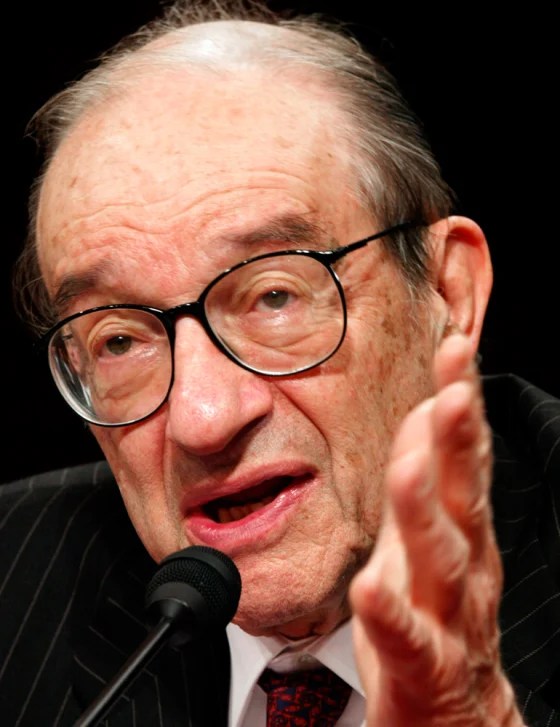
Alan Greenspan, Fed Chair from 1987 to 2006: glimpses into a fateful tenure and a defining era.
“Regulation – which is based on force and fear – undermines the moral base of business dealings... Protection of the consumer by regulation is thus illusory.”
— Alan Greenspan, “The Assault on Integrity,” in Ayn Rand et al., Capitalism: The Unknown Ideal, p. 120.
“Since I’ve become a central banker, I’ve learned to mumble with great incoherence. If I seem unduly clear to you, you must have misunderstood what I said.”
— Alan Greenspan, testimony before Congress; quoted in Alan Murray, “Fed Chief Sees No Acceleration in Inflation Rate,” Wall Street Journal, Sep 22, 1987, pp. 3.
“Government regulation can undermine the effectiveness of private market regulation… The introduction of government regulation may actually weaken the effectiveness of regulation if government regulation is itself ineffective or undermines incentives for private market regulation.”
— Alan Greenspan, “Government Regulation and Derivative Contracts,” remarks at the Financial Markets Conference of the Federal Reserve Bank of Atlanta, February 21, 1997.
“The use of a growing array of derivatives and the related application of more-sophisticated methods for measuring and managing risk are key factors underpinning the enhanced resilience of our largest financial intermediaries.”
— Alan Greenspan, “Corporate Governance.” May 8, 2003
“Those of us who have looked to the self-interest of lending institutions to protect shareholder’s equity (myself especially) are in a state of shocked disbelief… The whole intellectual edifice, however, collapsed in the summer of last year, because the data inputted into the risk management models generally covered only the past two decades, a period of euphoria.”
“An ideology is, is a conceptual framework with the way people deal with reality. Everyone has one. You have to — to exist, you need an ideology. The question is whether it is accurate or not. And what I’m saying to you is, yes, I found a flaw. I don’t know how significant or permanent it is, but I’ve been very distressed by that fact.”
Rep. Waxman: “You found a flaw in the reality…”
Greenspan: “Flaw in the model that I perceived is the critical functioning structure that defines how the world works, so to speak.”
Rep. Waxman: “In other words, you found that your view of the world, your ideology, was not right, it was not working?”
Greenspan: “That is — precisely. That’s precisely the reason I was shocked, because I had been going for 40 years or more with very considerable evidence that it was working exceptionally well.”
— Alan Greenspan, testimony before the U.S. House Committee on Oversight and Government Reform, October 23, 2008; PBS NewsHour, “Greenspan Admits ‘Flaw’ to Congress, Predicts More Economic Problems” / The Financial Crisis and the Role of Federal Regulators, 110th Cong., 2nd sess., October 23, 2008.
“I have grave concerns about the future of the Euro. The eurozone is not working.”
— quoted in Business Insider, “Alan Greenspan: ‘The Eurozone Is Not Working,’” February 26, 2017.
The following excellent books offer insightful critical perspectives on central banking, financial power, “deregulation”, and the broader political economy of of Alan Greenspan’s Fed era:
Davis, Gerald F. 2009. Managed by the Markets: How Finance Re-Shaped America. Oxford University Press.
Epstein, Gerald. 2019. The Political Economy of Central Banking: Contested Control and the Power of Finance. Edward Elgar.
Fligstein, Neil. 2021. The Banks Did It: An Anatomy of the Financial Crisis. Harvard University Press.
Jacobs, Lawrence R., and Desmond King. 2016. Fed Power: How Finance Wins. Oxford University Press.
Krippner, Greta. 2011. Capitalizing on Crisis: The Political Origins of the Rise of Finance. Harvard University Press.
MacKenzie, Donald. 2006. An Engine, Not a Camera: How Financial Models Shape Markets. MIT Press.
Mirowski, Philip. 2013. Never Let a Serious Crisis Go to Waste: How Neoliberalism Survived the Financial Meltdown. Verso.
Pixley, Jocelyn. 2018. Central Banks, Democratic States and Financial Power. Cambridge University Press.
Schwartz, Herman M. 2009. Subprime Nation: American Power, Global Capital, and the Housing Bubble. Cornell University Press.
***
Since you find value in the content and resources shared by the ES/PE community, please consider making a contribution to help sustain our work. Your support is vital to maintaining our independence and carrying forward our mission. Intellectual and civic solidarity matters now more than ever. Every contribution makes a meaningful difference and helps ensure the continuation of accessible scholarship and useful information. Donate securely now via this PayPal link.
Thank you!
Discover more from Economic Sociology & Political Economy
Subscribe to get the latest posts sent to your email.

Thank you.
Isidor Wallimann, Ph.D.
LikeLiked by 1 person
He was sleek, fast-talking, and ultimately shallow and short-sighted
LikeLiked by 1 person