In 2002, twelve years after Margaret Thatcher left office, she was asked, at a dinner for a Conservative politician Conor Burns, what her greatest achievement was. Thatcher replied: “Tony Blair and New Labour. We forced our opponents to change their minds.” (Conor Burns, April 11, 2008)
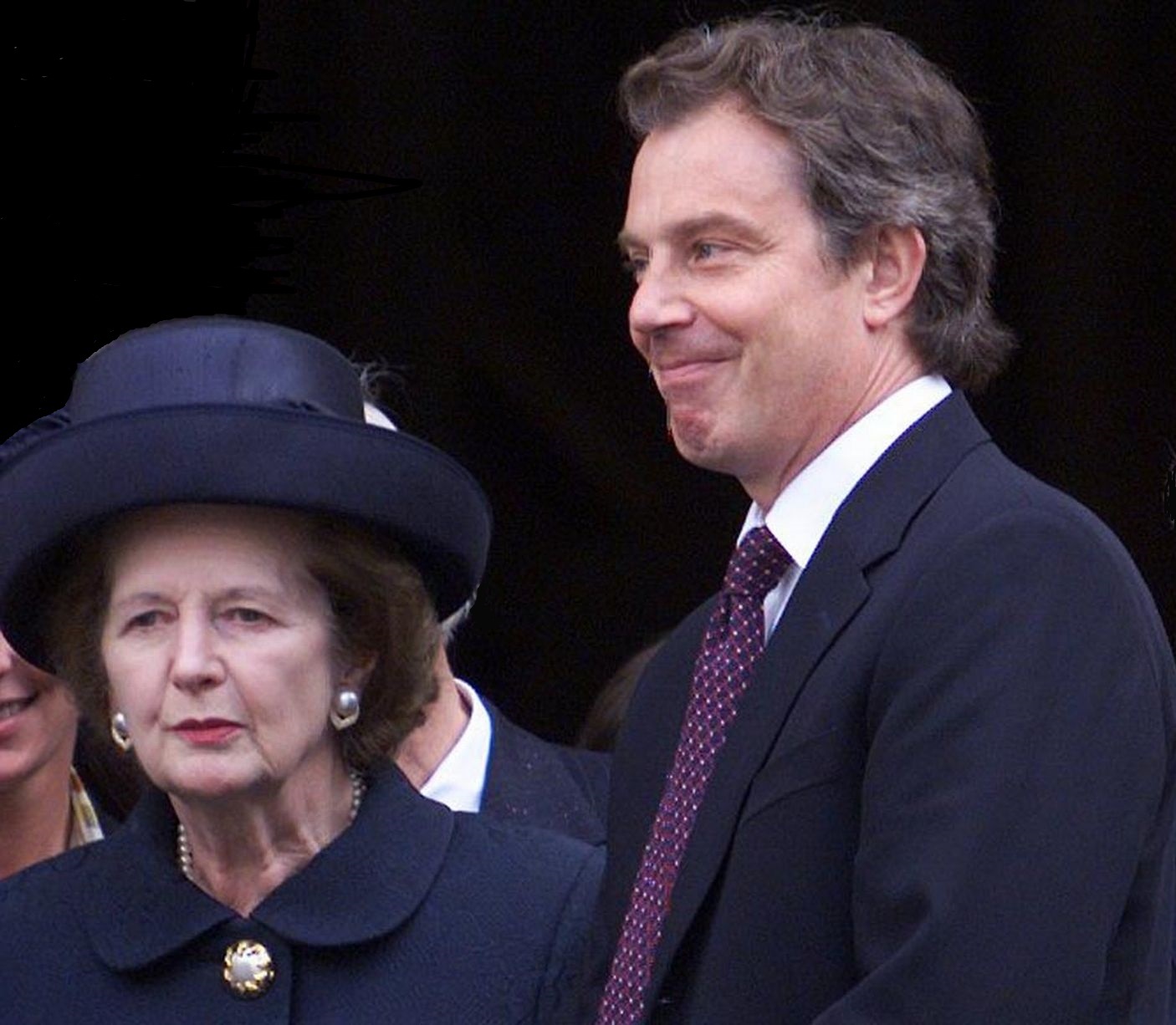
Not privatisation, not the Falklands, not the taming of inflation. “Tony Blair and New Labour.” This is a stranger claim than it sounds. Thatcher measured her success not by the statutes she passed but by the fact that her most determined opponent had abandoned its own assumptions and adopted hers. That is not an electoral victory; it is a claim about redrawing the boundaries of what counts as politically thinkable.
It is this claim that a body of British political-economy and political-sociology scholarship has spent the past two decades testing. Seven books, written from strikingly different traditions, converge on it with unusual consistency.
An early systematic treatment came from Colin Hay in The Political Economy of New Labour: Labouring under False Pretences? (1999). Hay places Labour’s modernisation within the changing political economy of Britain, bringing together globalisation, the transformation of the postwar state, Thatcherism’s legacy, and electoral competition. He also examines the strategic alternatives available to a Labour government and the prospects for a break with the Thatcher–Major settlement. This approach invites attention to how leaders interpreted the constraints they faced and defined the choices they considered viable. It helps us ask how much of New Labour’s accommodation reflected economic pressures, and how much reflected political judgements about winning office and governing within the inherited order.
Richard Heffernan, in New Labour and Thatcherism: Political Change in Britain (2000), places greater emphasis on Thatcherism’s role in establishing a new political consensus. He understands Labour’s transformation in relation to the changed environment of party competition and the party’s efforts to regain power. Yet the influence of Thatcherism on political leadership did not require a wholesale conversion of the electorate: support for welfare and collective provision persisted. His account thus directs attention to the relationship between party strategy, policy change, and the boundaries of political competition. Blair’s later words offer a revealing illustration of continuity: “Politicly, certain reforms she made, for example in Trade Union Law…, we kept the basic legal framework… We didn’t renationalise many of state industries that she privatized… I always thought my job was to build on some of the things she had done rather than reverse them… Many of the things she said… had a certain creditability.” (BBC interview, 8 April 2013) The statement illuminates his own understanding of his role, without settling the broader debate over why Labour changed.
Norman Fairclough approaches that transformation through language. In New Labour, New Language? (2000), he examines how speeches and policy texts helped construct New Labour’s political identity and present economic change as something to which government had to adapt. Language, in his account, participates in producing political positions as well as communicating them. He describes New Labour as post-Thatcherite: it took Thatcherism as a starting point, accepting some elements while rejecting or seeking to move beyond others. This adds a distinct dimension to the question of inheritance. Political language helped give an evolving project its form and legitimacy, combining elements drawn from different traditions rather than simply disguising an unchanged programme.
The institutional complexity of that inheritance comes into view in Gerry Stoker’s Transforming Local Governance: From Thatcherism to New Labour (2004). The book examines the changing governance of localities, including service delivery, political leadership, democratic participation, and partnerships among different actors. Stoker assesses New Labour’s reform ambitions and their uneven results, offering an account of both institutional change and the difficulties of bringing it about. His study encourages a more specific approach to the relationship between successive governments: inherited arrangements, new initiatives, and implementation problems need to be considered together. A mixed record of reform cannot by itself establish that Thatcherism simply persisted unchanged, but it shows why the relationship between political promises and institutional outcomes requires close examination.
Widening the lens, David Harvey’s A Brief History of Neoliberalism (2005) places Britain within a global history that includes Chile, the United States, and China’s market reforms. Harvey interprets neoliberalisation as a process that restored or strengthened the power of economic elites, connecting market reform to changes in class power. Privatisation, financial liberalisation, and the weakening of organised labour become parts of a broader political transformation in which states played an active role. This perspective allows New Labour’s accommodation to be considered alongside developments beyond Britain. It provides a wider context for asking how market-oriented assumptions acquired authority across political boundaries, while leaving the particular route of Labour’s transformation to be explained through its own history.
Simon Jenkins, in Thatcher and Sons: A Revolution in Three Acts (2007), follows Thatcher’s legacy through Major, Blair, and Brown. His account presents successive Conservative and Labour governments as participants in a longer transformation of British political life. Alongside economic policy, he examines the concentration of authority and the increasingly controlling character of government. This brings a tension within the legacy into focus: policies associated with market freedom could coexist with a powerful and interventionist executive. Jenkins therefore broadens the question of what New Labour inherited. Continuity could reside in habits of leadership and the organisation of authority as well as in particular economic commitments. His emphasis gives the discussion a further institutional dimension, connecting the survival of Thatcherism to ways of governing.
Alexander Gallas’s The Thatcherite Offensive: A Neo-Poulantzasian Analysis (2015) returns to the class relations underlying these changes. Drawing on Nicos Poulantzas, Gallas argues that Thatcherism shifted power towards capital through direct attacks on organised labour and a restructuring of the institutions sustaining class domination. Crucially, he distinguishes the politics of class relations from policies organising the economic order. In his account, New Labour broadly retained the inherited economic order while departing from the Thatcherite arrangement of class politics. Thatcherism mounted an offensive against labour; Blairism helped consolidate the gains secured through it. Gallas therefore offers a way to understand continuity alongside change: preserving an altered balance of power did not require reproducing all the political strategies through which it had been established.
Thatcher’s remark remains a useful starting point for thinking about political legacies. A government’s influence can endure through the assumptions and institutions its successors inherit, even as they revise policies and pursue different objectives. Read together, these books help explain why her claim still invites consideration, while giving us reasons to qualify it. The extent of her achievement lies partly in how her opponents came to understand the possibilities of governing after her.
— Fairclough, Norman. 2000. New Labour, New Language? London: Routledge.
— Gallas, Alexander. 2015. The Thatcherite Offensive: A Neo-Poulantzasian Analysis. Leiden, Netherlands: Brill.
— Harvey, David. 2005. A Brief History of Neoliberalism. Oxford: Oxford University Press.
— Hay, Colin. 1999. The Political Economy of New Labour: Labouring under False Pretences? Manchester, England: — Manchester University Press.
— Heffernan, Richard. 2000. New Labour and Thatcherism: Political Change in Britain. Basingstoke, England: Palgrave Macmillan.
— Jenkins, Simon. 2007. Thatcher and Sons: A Revolution in Three Acts. London: Penguin.
— Stoker, Gerry. 2004. Transforming Local Governance: From Thatcherism to New Labour. Basingstoke, England: Palgrave Macmillan.
Open Access PDF of this post is archived on SSRN.
For academic citation of this post, always use the following DOI:
https://doi.org/10.2139/ssrn.7488699
***
Since you find value in the content and resources shared by the ES/PE community, please consider making a contribution to help sustain our work. Your support is vital to maintaining our independence and carrying forward our mission. Intellectual and civic solidarity matters now more than ever. Every contribution makes a meaningful difference and helps ensure the continuation of accessible scholarship and useful information. Donate securely now via this PayPal link.
Thank you!
Discover more from Economic Sociology & Political Economy
Subscribe to get the latest posts sent to your email.

Haha, although New Labour moved closer to Conservative philosophy I don’t buy that they have helped the Conservative party long term. As of today, the party isn’t exactly popular.
LikeLike
@TheSociologicalMail “I don’t buy that [New Labour has] helped the Conservative party long term.”
Really? As of the May 2021 local elections, where Boris trounced the rebranded-New-Labour led by Keir Starmer (whose ‘bold vision’ now is [‘changing the things that need changing’] (https://jacobinmag.com/2021/05/keir-starmer-bbc-meltdown-labour-election-hartlepool ), it appears from the US as though the Tories will have ideological hegemony until such time as the Labour left ejects New Labour completely. Of course, that will also require a level of dewokification for which the left PCM seems utterly incapable.
LikeLike
[…] that — and not, say, New Labour’s refusal to once again control the financial sector Margaret Thatcher‘s Tories had deregulated — that was the cause of Britain’s supposedly precarious […]
LikeLike
[…] מתאצ'ר – שקראה לראש ה"ניו לייבור" טוני בלייר "ההישג הגדול ביותר שלה", ורונלד רייגן דרך פרנסיס פוקויאמה – שהכריז על […]
LikeLike
[…] > Thatcherism’s greatest achievement […]
LikeLike
[…] that — and not, say, New Labour’s refusal to once again control the financial sector Margaret Thatcher‘s Tories had deregulated — that was the cause of Britain’s supposedly precarious […]
LikeLike
[…] context that Margaret Thatcher, when asked what she considered her greatest achievement, replied “Tony Blair and New Labour. We forced our opponents to change their minds.”) Of course, many people committed to BlackLivesMatter may understand themselves as committed also […]
LikeLike
[…] Margaret Thatcher, quando questionada sobre o que ela considerava sua maior conquista, respondeu “Tony Blair e o Novo Trabalhismo. Forçamos nossos oponentes a mudar de ideia.”) É claro que muitas pessoas comprometidas com o BlackLivesMatter podem se entender como […]
LikeLike
[…] context that Margaret Thatcher, when asked what she considered her greatest achievement, replied “Tony Blair and New Labour. We forced our opponents to change their minds.”) Of course, many people committed to BlackLivesMatter may understand themselves as committed also […]
LikeLike
[…] wasn’t being facetious when she called “New Labour and Tony Blair” her greatest achievement. When her party was defeated in 1997, it was by an opponent […]
LikeLike
[…] is to change the soul”; and 3) when asked to identify her greatest achievement, she replied “Tony Blair and New Labour. We forced our opponents to change their minds.” The extent to which that sort of solipsistic individualism has spread in American life, […]
LikeLike
[…] to change the soul”; and 3) when asked to identify her greatest achievement, she replied “Tony Blair and New Labour. We forced our opponents to change their minds.” The extent to which that sort of solipsistic individualism has spread in American life, […]
LikeLike
[…] «Tony Blair y el Nuevo Laborismo. Obligamos a nuestros oponentes a cambiar de opinión» (“Tony Blair and New Labour. We forced our opponents to change their minds”). Así, la referente de la arremetida neoliberal aplaudía la deriva derechista del «Nuevo […]
LikeLike
[…] essential for the privatisation of the NHS to succeed. When asked about her greatest achievement, Margaret Thatcher famously answered, “Tony Blair and New Labour. We forced our opponents to change their […]
LikeLike
[…] was granted by Prime Minister Tony Blair in 1997. Not for nothing did Margaret Thatcher say her greatest accomplishment was “Tony Blair and New […]
LikeLike
[…] was granted by Prime Minister Tony Blair in 1997. Not for nothing did Margaret Thatcher say her greatest accomplishment was “Tony Blair and New […]
LikeLike
[…] כדי כל גם השמאל עבר תפנית נאו־ליברלית. טענתה של מרגרט תאצ'ר כי הישגה הגדול ביותר היה הופעתו של טוני בלייר והלייבור […]
LikeLiked by 1 person
[…] that Margaret Thatcher felt when, asked what her greatest achievement was, she replied, “Tony Blair and New Labour”. Xi’s reply to the same question in ten years may well be: “The end of Western democracy, […]
LikeLike
[…] De volgende periode begint aan het eind van de jaren 70, wanneer die rollen zich omdraaien. De Keynesianen worden vanuit de coulissen gedwongen te beschouwen wat het neoliberalisme onder Thatcher en Reagan in de praktijk betekent. De reflectie daarop leidt in de jaren 90 tot een derde periode die ook bekend staat als de derde weg. Onder leiding van Clinton, Blair en bij ons Kok, ontstaat een vorm van sociaaldemocratie, waarvan het klassieke economische onderstel – het Keynesianisme, neoliberale ideeën over markten in zich opneemt. Niet voor niets gaf Thatcher het volgende antwoord op de vraag wat haar grootste prestatie was: “Tony Blair and New Labour. We forced our opponents to change their minds.” […]
LikeLike
[…] experimentieren, und deren wichtigste westliche Vertreter in Reagan, Thatcher und später in ihrem vermeintlich “oppositionellen” Schüler Tony Blair. Diese Wirtschaftspolitik, die in verschiedenen Abwandlungen und Mutationen bis heute andauert, hat […]
LikeLike
[…] O., 2018. Thatcherism’s greatest achievement. [Online]Available at: https://economicsociology.org/2018/03/19/thatcherisms-greatest-achievement/%5BAccessed 9 9 […]
LikeLike
[…] But Blair also learned from the Thatcher years and political PR and spin became more prevalent than ever. This is perhaps just one of the reasons that Thatcher regarded Blair and New Labour as amongst her greatest achievements. […]
LikeLike
[…] was her ideological triumph that when asked what her greatest achievement was Thatcher replied “Tony Blair,” since he continued her self-focused anti-society mission. That was before her descent in […]
LikeLike
[…] Thatcher once said that her greatest achievement was Tony Blair due to the shift Labour took to the right under his leadership in abolishing Clause Four. That […]
LikeLike
[…] Thatcher, memorably asked about her greatest political accomplishment in 2008, once famously responded that it was Tony […]
LikeLike
[…] Labour. We forced our opponents to change their minds.” (Conor Burns, April 11, 2008) https://economicsociology.org/2018/03/19/thatcherisms-greatest-achievement/ [accessed 1st June 2024, […]
LikeLike
[…] Whether it was Thatcher and Thatcherism that moved society and higher education in this direction or global or bottom up forces is still debated. The Labour Party also changed significantly throughout the decade and continued to do so until they entered Downing Street in 1997. A victory that Margaret Thatcher claimed as one of her biggest successes and legacies – she later said that the arrival of Tony Blair and New Labour demonstrated how she had forced her opponents to change their mind. […]
LikeLike
[…] Thatcherism’s greatest achievement, Sociologie Économique & Économie Politique19 Mars 2018 […]
LikeLike
[…] of national politics and out of parliament. Thatcher herself regarded New Labour as her greatest achievement. As the interests of organised labour ceased to be represented in politics, parliament was deprived […]
LikeLike
[…] Margaret Tatcher, se le preguntó en 2002 acerca de cuál fue su mayor logro como primera ministra, ella respondió satisfecha: «Tony Blair y el Nuevo Laborismo, obligamos a nuestros oponentes a cambiar de […]
LikeLike
[…] del destino sino una contradicción inevitable del sistema. ¿Recuerdan cuando Margaret Thatcher dijo, no sin orgullo, que Anthony Blair era el mayor logro de su […]
LikeLike
[…] Thatcherism’s greatest achievement […]
LikeLike
[…] views in favour of defeating the left within his own party, paving the way for Thatcher’s self-professed greatest achievement: ‘Tony Blair and New Labour. We forced our opponents to change their […]
LikeLike
[…] Thatcher was asked in 2002 what her greatest achievement was, she quipped “New Labour,” viewing the Blair-era party as sensibly sticking to her own 1980s economic […]
LikeLike
[…] after she left office, Margaret Thatcher was asked to name her greatest accomplishment, and she famously replied: “Tony Blair, and New Labour.” Meaning: although it had begun life on the margins as a thought […]
LikeLike