
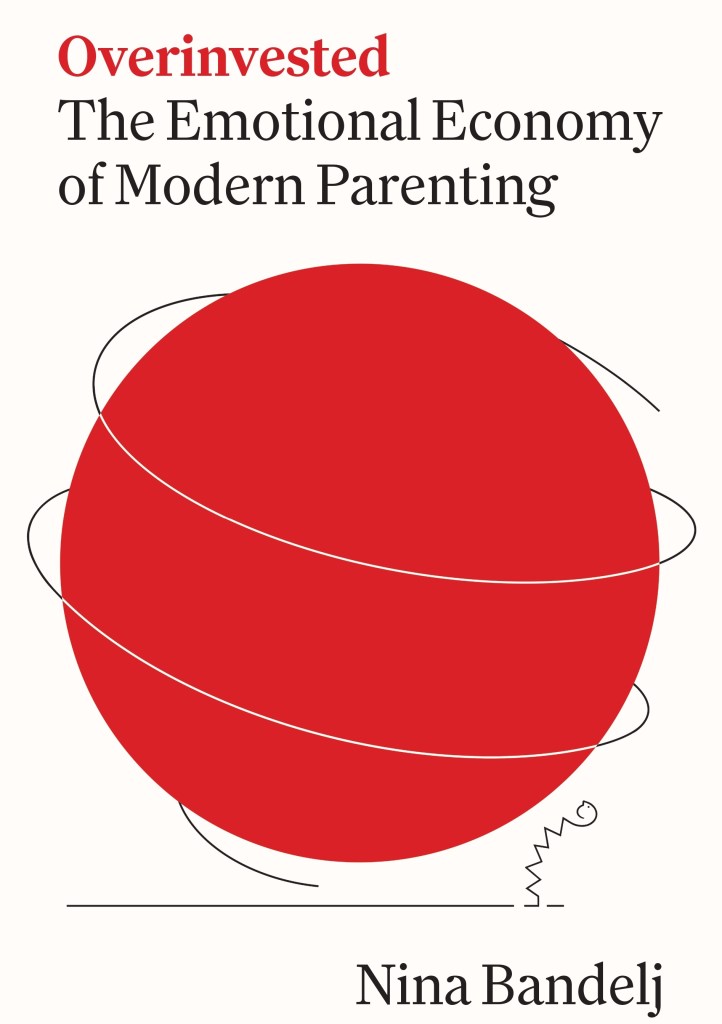
by Nina Bandelj*
In the summer of 2024, U.S. Surgeon General issued a public health advisory about something that would have seemed an unlikely candidate for federal alarm: parenting. More than 40 percent of American parents, his office reported, say that most days they are so exhausted they cannot function. One in two feels constantly overwhelmed. Media reported on “parental burnout,” a term that barely existed before 2015 and shot up in written word use around 2018, well before the pandemic, which forced the subject of exhausted parents into public view. Something has gone seriously awry in the way American society organizes the raising of children. The story of how we arrived here is a sociological story about how economic reasoning and emotional culture combined to transform child-rearing into exhausting labor and children into investment projects, with troubling consequences.
That is the central argument of my new book Overinvested: The Emotional Economy of Modern Parenting. Drawing on interviews with 120 American parents across diverse class, racial, political, and religious backgrounds, content analysis of more than a century of parenting advice literature, intellectual history of economic ideas, and quantitative household-level data from the Survey of Consumer Finances, Panel Study of Income Dynamics and Survey of Consumer Finances, the book traces how a culturally specific and historically recent model became the default standard for good parenting in the United States.
From Economically Useful to Emotionally Priceless — and Beyond
The transformation begins with a well-documented historical shift from economically useful to emotionally priceless children across the late nineteenth and early twentieth centuries (see Zelizer’s Pricing the Priceless Child, 1985). Child labor laws, culminating in the Fair Labor Standards Act of 1938, codified society’s retreat from children’s economically productive value. Court cases from the era make the cultural shift viscerally legible: damages awarded for a child’s death were no longer calculated in lost wages but in parental “mental pain and anguish.”
But Overinvested argues that something further happened in recent decades. Children are not merely treasured; they are now treated as investment projects. One vehicle for this shift is the popularization of the concept of “human capital,” including the 1992 Nobel Prize award to economist Gary Becker, whose work helped normalize the idea that individuals should invest into building their human capital to help increase economic growth. Becker applied this also to households. The description of his A Treatise on the Family (1981) begins with an invitation: “Imagine each family as a kind of little factory.” By this logic, parents start building human capital of their children earlier and earlier, and child-rearing is a capitalization project. This sounds cold when stated plainly, and that is partly the point. We have so thoroughly naturalized the language of human capital that we rarely notice how strange it once seemed to use it to refer to human beings.
This preoccupation with human capital is also one reason why the share of household expenditure on childcare and education increased eightfold between the 1960s and 2015. Childcare costs in the United States now exceed in-state public college tuition in the majority of the 52 states. Mortgages are inflated by the desire to access better school districts. College loan balances that parents have for their children often exceed those that children themselves have. Extracurricular activities feed a youth sports industrial complex estimated at $20 billion. Tutoring markets are projected to reach $9 billion domestically and $200 billion globally by the end of 2026.
At the same time, ninety-four percent of American parents say that being a parent is extremely or very important to their identity. Parenting has become a site not only of child-rearing but of parent identity-building, and that emotional burden is felt as acutely as any budget constraint. The pressure to invest is in equal parts financial as it is emotional.
The Rise of Economization Together with Emotionalization
How did this happen? The book identifies two mutually reinforcing societal changes. The first is the rise of the Economic Style: the spread of economic reasoning into intimate life, a phenomenon that sociologist Elizabeth Popp Berman (2022) has traced through American public policy in her book Thinking Like an Economist. The second is the rise of the Emotional Style: an intensifying therapeutic culture that makes us default to emotions in the way we see ourselves and others. As parenting goes, emotionalization of life puts children’s and parents’ emotional experience at the center of attention, saturating everything from parenting books to mom influencer Instagram reels to WhatsApp parent groups. The Economic and the Emotional Styles are not, as one might expect, in tension. Rather, they amplify each other, so money becomes a language of love and investment becomes devotion. The logic of optimizing a child’s development is experienced not as cold calculation but as the deepest form of care.
Notably, parents themselves rarely speak of investments and returns. Parents we interviewed spoke of love, support, and sacrifice. One father described it would be “heartbreaking” if family finances imposed constraints so he could not do everything he wanted for his children. One mother described her days as governed by an unyielding clock, choreographing school pickups and multiple children’s activities with the precision of a shift worker and a sense of religious devotion to do it all for her children. She also did a lot of invisible cognitive labor of parenting, acts of anticipating, researching, deciding and monitoring, disproportionately borne by mothers (cf. Daminger’s What’s on Her Mind: The Mental Workload of Family Life, 2025).
Inequality’s Engine
Perhaps the book’s most urgent finding is structural. The societal pressure of parental overinvestment does not only exhaust parents or constrain children’s growing independence, although there is compelling evidence it does both, with reduced chores that kids do at home, less support of part-time jobs for teenagers, and diminished free play that psychologists have linked to lower resilience in young adulthood (Gray, 2013). The norm of invested parenting also deepens inequality. Wealthier families accumulate assets, such as federal tax advantaged 529 education savings or money market account funds under their children’s names, while lower- and middle-income families increasingly take on debt, particularly mortgage debt incurred to access better school neighborhoods. Black families bear a disproportionate share of education debt for their college age children. The privatization of child-rearing, in a policy environment that remains stubbornly family-unfriendly by international standards, means that the engine of American parenting is simultaneously an engine of growing economic and racial inequality.
Toward a shared responsibility
“It takes a village to raise a child” sounds cliché, but Overinvested asks us to hear it again as a structural claim and call to action. Children are not solely parental investment projects. They are members of society, and we need to reimagine their social value as a shared societal responsibility rather than a private portfolio to be optimized. Structural changes across institutions of family, finance and education are needed to support cultural transformations and mend the social fabric that privatized parenting today unravels. The finance industry, youth sports industrial complex, shadow education business, and parenting advice overload that all capitalize on parental anxieties and joys of the-hardest-but-most-rewarding job, will likely resist such change. But sociologists—and parents at the brink of exhaustion—are here to sound the alarm.
——————–
* Nina Bandelj is Chancellor’s Professor in Sociology at the University of California, Irvine, and past president of the Society for the Advancement of Socio-Economics. This blog is based on her newest book, Overinvested: The Emotional Economy of Modern Parenting (Princeton UP, 2026). Among her previous books are Money Talks: Explaining How Money Really Works, The Cultural Wealth of Nations, and Economy and State: A Sociological Perspective.
***
Since you find value in the content and resources shared by the ES/PE community, please consider making a contribution to help sustain our work. Your support is vital to maintaining our independence and carrying forward our mission. Intellectual and civic solidarity matters now more than ever. Every contribution makes a meaningful difference and helps ensure the continuation of accessible scholarship and useful information. Donate securely now via this PayPal link.
Thank you!
Discover more from Economic Sociology & Political Economy
Subscribe to get the latest posts sent to your email.
