by Ivan Light*
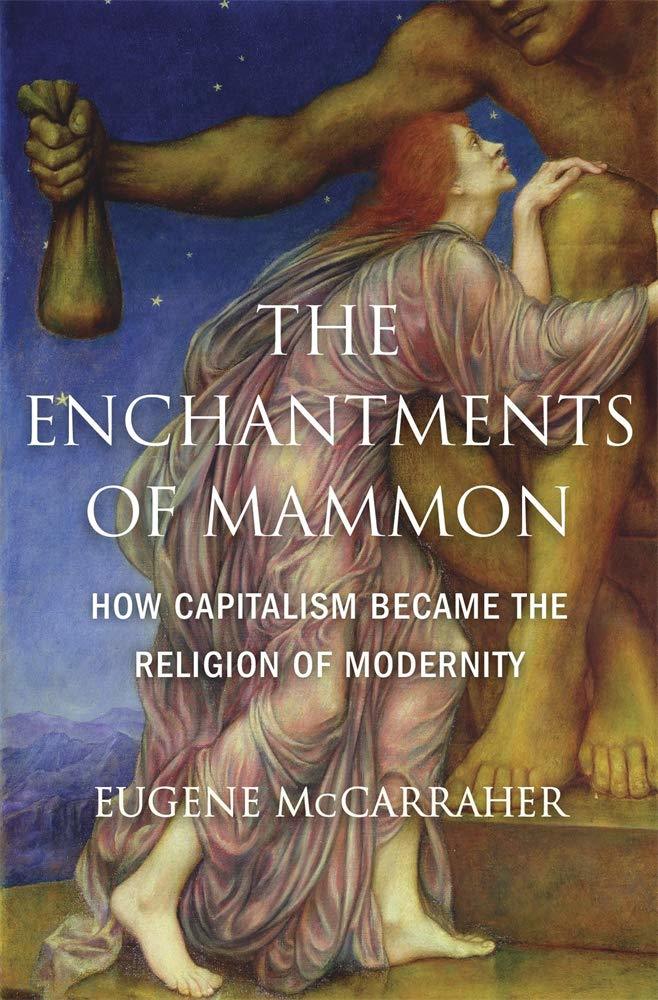
A review of Eugene McCarraher’s The Enchantments of Mammon: How Capitalism became the Religion of Modernity. Harvard University Press.
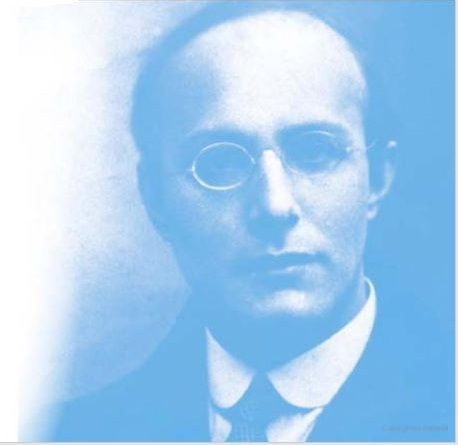
Max Weber famously declared in 1917 that the “disenchantment of the world” was the master process of modernity. Disenchantment denoted a long-term trend toward secularization and rationalization that systematically reduced the influence of religion, magic, superstition and of traditional authorities, both legal and civil. Since the sixteenth century, capitalism has been the engine of disenchantment, and its willing accomplice is natural science. This team has massively improved the material wellbeing of everyone on earth as measured in terms of health, comfort, length of life, calories, education, transportation, and so forth.
People welcome the material abundance capitalism brought but they mourn lost enchantments. Recall that one meaning of enchantment is pleasure or delight. City folk miss the small-town community and lowing herds that their peasant forebears knew. But their emotional loss is deeper than nostalgia says Eugene McCarraher. Capitalism “evacuated sacredness from material objects and social relationships.” Loss of the sacred was profoundly destructive to human wellbeing. Most basically, McCarraher continues, this is because disenchantment “separates ontology and ethics.” Under a regime of economic and social traditionalism, sacred enchantment guaranteed that whatever was ought to be. Capitalism dissolved this marriage, leaving people free rationally to rearrange their affairs for personal advantage in defiance of custom. The divorce of is from ought confronted people with the terrifying incapacity of facts to generate values. In the resultant confusion, sacrilege could be enacted. A particularly horrifying example is the demotion of nature that capitalism effectuated. Under the canopy of enchanted tradition nature had been sacred. McCarraher calls nature, “God’s Vice-Regent.” Despoliation of nature was sacrilege. Under capitalism, nature became “a bundle of resources” open to reckless despoliation for profit.
McCarraher stipulates that humans require sacred enchantments. He calls those sacred enchantments “religions.” From the identification, he slides easily into the declaration that “capitalism became the religion of modernity.” This is “more than a metaphor.” The “pseudo-science of economics” provides the religion of capitalism’s “theology philosophy, and cosmology.” Capitalism’s creed is Mammonism, which attributes “ontological power to money and existential sublimity to its possessors.” McCarraher acknowledges that this was Karl Marx’s judgment too, but McCarraher is a staunch Roman Catholic and a professor of history at Villanova University. As such, McCarraher finds capitalism “a fraudulent religion” because it represses, displaces, and renames “our intrinsic longing for divinity.”
Stipulating an “intrinsic longing for divinity” will disincline social scientists from reading further. That would be a pity. Additionally, labeling capitalism “a religion” is likely to cause social scientists to debate whether capitalism is a religion. [1] Valid in themselves, these objections miss the main point of this splendid book. In the centuries since capitalism was transplanted to North America, there is every theoretical reason to expect popular values increasingly to conform to the dominant economic system. Indeed, in the mood of economic triumphalism that now exists, agreeing with McCarraher, some neo-classical economists have claimed exactly that. [2] Moreover, there is every reason to expect that a historical survey of cultural products will show evidence of this convergence over time. Additionally, McCarraher endorses Weber’s Protestant ethic hypothesis. “The Puritan doctrine of calling was the first covenant theology of capitalism.” The bulk of his book then provides the empirical test of its long-term consequences that social science had long needed. The Puritans believed that God would reward with wealth those who worked hard, saved their money, and lived simply. The work, thrift, and asceticism have now vanished from the formula. The evidence of the book shows how this Puritan formula gradually turned into the fetishistic enchantment with money that dominates American society today. What began as God will give you money became money is God.
Finally, the evidence McCarraher presents is extraordinarily rich and comprehensive. In this book of 800 pages, possibly 60 pages are theoretical. The other 740 pages review a vast swathe of cultural products over 400 years. In addition to the history of Protestantism in America and of management theory, the topics addressed include visual artists, novelists, poets, advertising theorists, populist journalists, Christian socialists, Arts and Crafts advocates, socialists and anarchists, Catholic workers, philosophers, the Frankfurt theorists, bohemian Greenwich Village, hippies, utopian communities, celebrants of Fordism, architects, the occupy movement, entrepreneur worshipers and many more. McCarraher addresses the writers in the context of each one’s scholarly literature, adding his own aperçus, and focusing the discussion on how they moved or opposed the faith that “what has no price has no value” and that, conversely, the value of anything or anyone is proportional to its price.
McCarraher does not hide his disdain for capitalism, nor the Roman Catholic grounding whence his viewpoint springs. It feels occasionally as if an implicit subtext is to discredit the Reformation by showing its deplorable long-term consequences. Nonetheless, if partisan, this is not a lopsided or unfair review. McCarraher presents advocates of capitalism as well as critics. Predictably, their debate has been continuous over the decades, but in the end capitalism’s advocates won it and now hold the field. The scholarship of this book is magnificent, the prose is enchanting, if sometimes flamboyant, and it is a rare reader who will not come away with a list of many new interests to review and new authors to read.
The book’s historic scope ends in 1975. In a brief epilogue, McCarraher connects to current events, notably Trump’s presidential cabinets, “straight out of the pages of Marx and Engels.” Comfortable with Marxist analysis, McCarraher is no fan of socialism. His alternative economic vision favors craftsmanship and small shop production over alienated workers and managerial hierarchy despite the superior efficiency of large, capital-intensive factories. He prefers anarchism to socialism for the same reasons. Alienation and regimentation are too high a human cost to pay for abundance because life is not centrally about getting and spending. “Our best hope for an imaginative and political antithesis to capitalist enchantment resides in the lineage of Romantic, sacramental radicalism.” Hippy communes might fit this model. He also recommends a relaxed outlook on life that, taking no thought for the morrow, casts its bread upon the waters, and assumes the generosity of a benign nature.
Obviously, New Testament economic principles contradict conventional economic wisdom, and recommending them will draw the ridicule of businesspeople and economists. Desiring to avoid a debate that is ultimately about values, I propose to explore instead how usefully to extend McCarraher’s research direction into a related topic, social Darwinism. Contrary to McCarraher, the case for a scarcity-dominated view of nature, which he deplores, does not derive exclusively or even mainly from economics or Protestants. It derives mainly from evolutionary biology according to which nature tests species against the environment and ruthlessly discards species that fail. As Abraham Lincoln put it, “root hog, or die.” In the late nineteenth century, William Graham Sumner (1840-1910) taught Americans to understand capitalism through the lens of social Darwinism. In Sumner’s vision, markets promoted the most fit to the most remunerated positions and condemned the less fit to hew wood and draw water. Because of natural selection, one’s wealth corresponded exactly to one’s fitness for survival. Rich entrepreneurs had proven themselves the fittest to survive; they merited authoritarian powers. Conversely, the poor and unemployed were a burden on everyone else. Sumner’s view is still popular among very rich Americans and has drawn Trump’s explicit endorsement. [3] The fit of social Darwinism with the Protestant ethic is tight; either way, wealth equals virtue. But McCarraher ignored the social Darwinists and so overlooked this convergence. That weakened his argument. There is a favorable presumption here for future research.
References:
[1] Declaring a repugnant ideology “a religion” is a common way to discredit it. In his 1938 classic Anatomy of a Revolution, historian Crane Brinton declared communism a religion. A recent Wall Street Journal editorial describes Karl Marx as the founder of a fanatical religious cult.
[2] Branco Milanovic, Capitalism Alone (Harvard University, 2019).
[3] Ivan Light, Entrepreneurs and Capitalism since Luther. Lexington Books, 2020, esp. chs. 7, 8. 9. Also, Ivan Light, “Trump’s charisma.” Critical Sociology, 23 April 2022.
—————–
* Ivan Light, Professor emeritus of sociology, University of California, Los Angeles. Among his books are Entrepreneurs and Capitalism Since Luther (2020), Deflecting Immigration: Networks, Markets, and Regulation in Los Angeles (2006), Ethnic Economies (2000), Immigration and Entrepreneurship: Culture, Capital, and Ethnic Networks (1993), Immigrant Entrepreneurs: Koreans in Los Angeles (1988).
***
Since you find value in the content and resources shared by the ES/PE community, please consider making a contribution to help sustain our work. Your support is vital to maintaining our independence and carrying forward our mission. Intellectual and civic solidarity matters now more than ever. Every contribution makes a meaningful difference and helps ensure the continuation of accessible scholarship and useful information. Donate securely now via this PayPal link.
Thank you!
Discover more from Economic Sociology & Political Economy
Subscribe to get the latest posts sent to your email.
