
by Ilan Talmud*
In 2017, a heated debate over block size limits split Bitcoin’s developer community, leading to the creation of Bitcoin Cash. To engineers, it was a technical scaling problem; to miners, an economic threat; to activists, a betrayal of decentralization ideals. This moment is not merely a footnote in cryptocurrency history. It reveals how Bitcoin functions less as a finished technology and more as a boundary object: a shared yet contested artifact that different groups interpret, reshape, and mobilize for divergent ends.
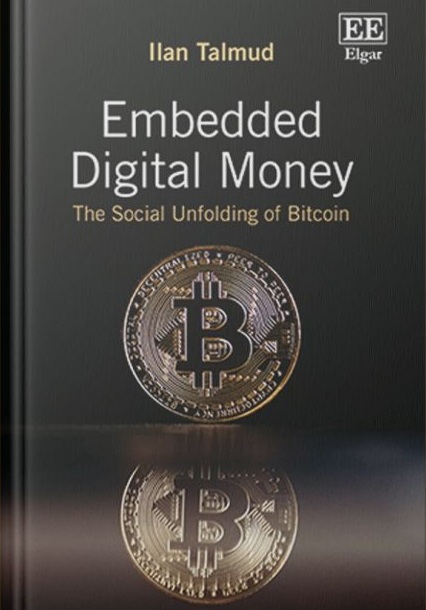
Embedded Digital Money: The Social Unfolding of Bitcoin offers a sociological reading of Bitcoin as a complex socio-technical phenomenon. Rather than treating it as an isolated technical invention or as a passing speculative bubble, the book understands Bitcoin as an ongoing social process through which meaning, trust, value, and authority are produced. Its starting point is that Bitcoin, which emerged on the margins of cryptographic communities in the aftermath of the 2008 financial crisis, rapidly became a force challenging the foundations of the contemporary monetary order: the roles of states, central banks, commercial banks, capital markets, and regulatory institutions.
The book’s central argument is that Bitcoin is not “disembedded money,” as some of its advocates often portray it. On the contrary, it is embedded in a dense web of infrastructures, institutions, norms, narratives, and power relations. Its operation depends on electricity grids, global hardware and semiconductor supply chains, exchanges, venture capital, trading tools, legal classifications, and the everyday practices of user communities. Thus, Bitcoin’s promise to create money free from states and banks does not eliminate its social embeddedness; rather, it highlights the depth of its dependence on existing social structures.
The research on which the book is based combines an analysis of global websites and forums devoted to Bitcoin with a multi-sited ethnography of the Israeli Bitcoin community. Over several years, I participated in meetings and events organized by this community, adopting a qualitative approach in order to allow the field itself to surprise me and to reveal issues that could not have been anticipated in advance. This approach makes it possible to trace how community members understand Bitcoin, explain it, and mobilize around it emotionally, ideologically, and economically.
One of the book’s central findings concerns the importance of “folk theories” among Bitcoin activists. Rather than encountering only cold, calculating investment logic, we come across vivid stories, metaphors, and images. The most prominent of these is the idea of “digital gold,” which presents Bitcoin as a hedge against the deterioration of state-issued money and as a potential alternative to the banking system. Such narratives are not merely decorative; they function as a form of “social glue” that helps the community cope with price volatility, sustain trust, and shape a collective identity.
Another central dimension of the book is time. I find that temporal orders are not merely a backdrop to community activity but a structural component of the protocol itself and of the socio-technical imagination built around it. The pace of mining, the timetables of upgrades, expectations about the future, and narratives of an ongoing economic revolution all shape how Bitcoin is understood and used. In this sense, time becomes not a passive background but a hidden architecture of the system.
The book also analyzes Bitcoin as a “boundary object.” The same currency carries different meanings for developers, traders, regulators, and ordinary users. There is no agreement on what Bitcoin “really is,” yet these groups are still able to coordinate action around it. Over time, the book argues, the significance of the single object gave way to a dynamic “boundary infrastructure” — an assemblage of wallets, exchanges, compliance procedures, legal definitions, trading tools, and community practices — that enables diverse groups to plug into the system and turns Bitcoin into a recognized financial asset.
At the theoretical level, this research integrates economic sociology, science and technology studies, actor-network theory, the sociology of time, and theories of regulation. It emphasizes that economic devices do not merely represent markets; they help enact them. Charts, wallet interfaces, algorithms, and protocol rules shape behavior, expectations, and trust. At the same time, the book reminds us that the contemporary monetary system is layered and hierarchical, and that Bitcoin enters it at an awkward angle: it is too volatile to stabilize prices, yet too visible and symbolically charged to be ignored.
When Code Meets Community: Bitcoin as a Boundary Object in Practice
Understanding Bitcoin through the lens of “boundary objects,” a concept originally developed in science and technology studies (STS), helps explain why governance in decentralized systems is so fraught, and the ways in which regulatory efforts often miss their mark. Rather than asking whether Bitcoin “works” as money or technology, we might ask: how does it sustain coherence while enabling radical disagreement?
Much public discourse treats Bitcoin as either a revolutionary payment system or a speculative asset. Both frames overlook Bitcoin’s deeper sociological attribute. Bitcoin operates as a socio-technical experiment in which technical protocols, community norms, legal boundaries, and market dynamics co-evolve. Its code does not dictate outcomes; instead, it provides a flexible scaffold that different actors—developers, miners, exchanges, regulators, users—interpret and act upon in conflicting ways.
Proposals to increase block capacity were technically straightforward, yet they triggered a crisis because they threatened existing power distributions and ideological commitments. Developers emphasized security and decentralization; miners prioritized transaction fees and profitability; some users feared corporate capture. The result was not a technical fix but a social fusion: a fork that created parallel communities with incompatible visions of Bitcoin’s future.
This pattern recurs. Whether debating proof-of-work versus proof-of-stake, privacy enhancements, or layer-two scaling solutions, technical proposals become proxies for deeper struggles over authority, identity, and control. Bitcoin’s protocol is stable enough to coordinate action, yet open enough to accommodate reinterpretation—a hallmark of boundary objects in other domains, from scientific classification systems to environmental policy frameworks.
Viewing Bitcoin as a boundary object shifts the analytical focus from “What is Bitcoin?” to “What does Bitcoin do for different groups?” This reframing has two implications: First, it clarifies why governance is so contentious. Boundary objects thrive on interpretive flexibility: they allow diverse actors to collaborate without full consensus. But this flexibility also means that every technical change becomes a site of negotiation over values and power. Governance failures are not bugs. Rather, they are features of a system designed to accommodate pluralism.
Second, it sheds light on Bitcoin’s role in reconfiguring social boundaries. As different groups engage with Bitcoin, they redraw lines between insiders and outsiders, legitimate and illegitimate uses, core and peripheral contributions. These boundaries are not fixed; they shift as new actors (e.g., institutional investors, nation-states adopting legal tender status) enter the ecosystem. The result is a continuously evolving social topology, not a static technology.
A case in point: institutional adoption and ideological tension
The recent entry of major financial institutions and even nation-states into Bitcoin markets illustrates these dynamics. When a country like El Salvador adopted Bitcoin as legal tender, it was not merely making a monetary policy decision. It was aligning with a particular narrative regarding sovereignty, financial inclusion, and technological modernity. Meanwhile, institutional investors treat Bitcoin as a hedge asset, largely indifferent to its decentralization ethos.
These divergent engagements do not destabilize Bitcoin. Instead, they reinforce its boundary object status. The protocol remains intact while accommodating incompatible interpretations. Yet this accommodation generates friction: ideological purists decry institutional “co-optation,” while newcomers push for regulatory clarity that may constrain the very flexibility that enabled Bitcoin’s growth.
This tension is productive. It forces ongoing renegotiation of what Bitcoin is and who gets to decide. The alternative, rigid centralization, could resolve governance disputes but would undermine the decentralized, experimental character that defines Bitcoin’s social unfolding.
Broader Implications and Concluding Reflections
For scholars, the boundary object lens suggests new research questions: How do different communities stabilize or destabilize Bitcoin’s meaning? What mechanisms allow technical protocols to persist amid social fragmentation? How do regulatory interventions reshape, rather than resolve, interpretive conflicts?
For policymakers, the lesson is humility. Attempts to govern Bitcoin as a monolithic entity will likely fail or produce unintended consequences. Instead, modular, context-sensitive approaches that acknowledge Bitcoin’s multiplicity may be more effective. This might mean regulating specific use cases (e.g., exchange-traded products) while leaving others (e.g., peer-to-peer transactions) less constrained.
Bitcoin’s trajectory raises unresolved questions that invite further debate: Can a boundary object sustain coherence indefinitely, or will fragmentation eventually produce irreconcilable forks? How should regulators balance the need for consumer protection with the recognition of interpretive pluralism? What happens when state actors (e.g., central banks issuing digital currencies) enter the same semantic space as decentralized cryptocurrencies?
These are not merely technical or legal questions; they are sociological questions about how societies negotiate meaning, authority, and trust in an era of distributed technologies.
In sum, Embedded Digital Money presents Bitcoin as an ongoing social experiment that reveals how code, law, narratives, and institutions intersect in the creation of new monetary orders — while often preserving older hierarchies and inequalities. The book does not offer a total explanation; rather, it adopts a consciously “partial explanation,” tracing specific chains of meaning, power, and interest. Precisely this recognition of the limits of explanation is a condition for a deeper understanding of what Bitcoin has become — and of what it may yet become.
———-
Ilan Talmud is Professor Emeritus in the Department of Sociology at the University of Haifa, Israel. His research interests include economic sociology, the digital economy, social network analysis, and Internet studies. One of his previous books is Wired Youth: The Online Social World of Adolescence (2nd edition, 2020; co-authored with Gustavo S. Mesch).
***
Since you find value in the content and resources shared by the ES/PE community, please consider making a contribution to help sustain our work. Your support is vital to maintaining our independence and carrying forward our mission. Intellectual and civic solidarity matters now more than ever. Every contribution makes a meaningful difference and helps ensure the continuation of accessible scholarship and useful information. Donate securely now via this PayPal link.
Thank you!
Discover more from Economic Sociology & Political Economy
Subscribe to get the latest posts sent to your email.
