
by Andreas Nölke*
The share of emerging markets in the global financial system has grown tremendously during the last decades. This is particularly true for the large economies that are members of the G20 (Argentina, Brazil, China, India, Indonesia, Mexico, Russia, Saudi Arabia, South Africa and Türkiye). According to the IMF, not only has their share of global trade and investment almost doubled during the last twenty years, but also their integration into global finance has made great advances, particularly in the cases of China, Brazil and India.
However, discussions in political economy literature diverge considerably in their assessments of the situation of these countries vis-à-vis the forces of the global financial systems. While there is broad agreement that these countries have all undergone broader processes of financialization, which has emerged in the established economies some decades ago, observers disagree on their ability to mold these forces to their advantage.
On the one hand, scholars of international financial subordination argue that the structured hierarchies between nation states in global markets are particularly pronounced in the field of finance. Correspondingly, the monetary, fiscal and exchange rate policies of emerging markets are continuously forced to react to changing circumstances in the more established economies, instead of using finance for their own developmental priorities. Moreover, proponents of this view argue that a focus on the appropriate policies on how to deal with these hierarchies are problematic, since they ignore the deeply uneven nature of capitalism and tend to reproduce a Eurocentric perspective.
On the other side, researchers working on financial statecraft argue that governments (also) in emerging markets are well able to deal with these challenges, by using national policy options to attain their priorities, particularly with regard to the bigger foreign policy picture. A core bone of contention then is whether private sector financial sector actors call the shots – as argued by the subordination literature – or national governments, as highlighted by the statecraft camp. Until recently, there has been only limited interaction between these two literatures which paint two very different pictures of the role and capacity of emerging markets within the global financial system, and few attempts have been made to explain these different outcomes, that is, (degrees of) subordination and/ or statecraft between emerging markets.
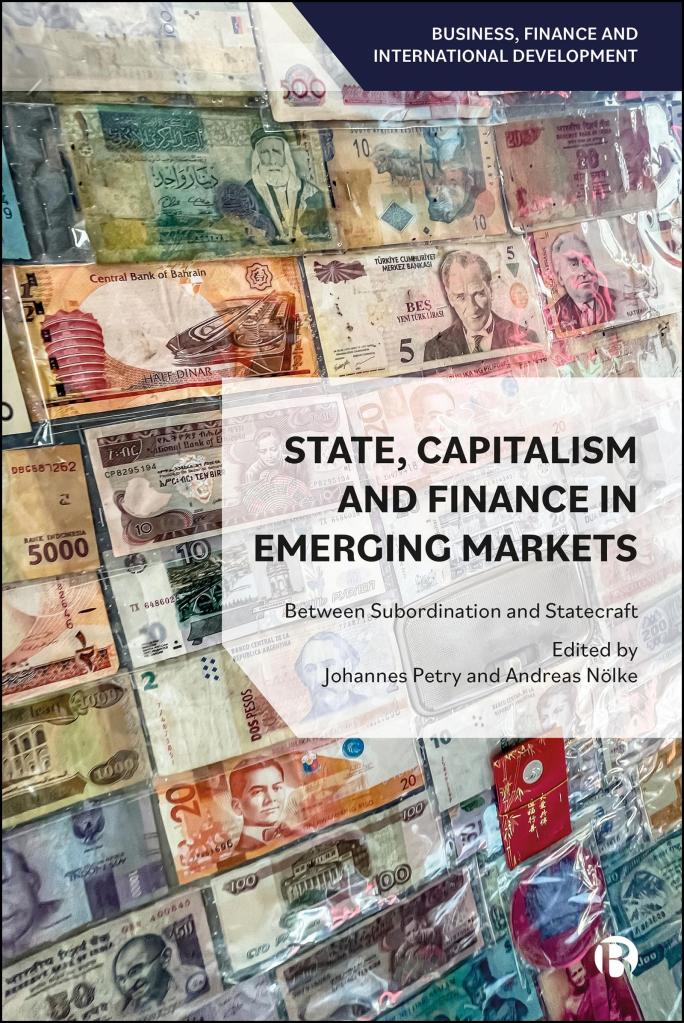
In an effort to build bridges across academic communities, our recent book State, Capitalism and Finance in Emerging Markets (Bristol University Press, 2025) has assembled leading authors from both camps and invited them to confront each other’s arguments. This also seems necessary because authors tend to be based in different geographical regions, with the statecraft literature being more prominent in the United States, and the subordination camp in Europe and countries of the South.
We address this lacuna by bringing together these two strands of literature and further enriching the debate by bringing it into conversation with insights from the comparative capitalism literature. The core argument of the book is that variety in national capitalist institutional settings is crucial for understanding state capacity and state reach of emerging markets in the realm of finance. It provides us with a conceptual lens to understand how emerging markets can navigate tensions and their positionality between subordination and statecraft, leading to very different outcomes. To this end, the book contains empirical studies that are inspired by these perspectives, mostly focusing on the countries of the BRICS grouping.
Studies on Brazil and South Africa, for example, support the subordination view. In South Africa, a deeply neoliberal approach towards financialization has led to an extreme form of financial subordination, particularly since the post-apartheid period of financial deregulation. This has led to many severe problems, including capital flight, currency volatility, repeated stock market crashes, low levels of fixed investments, a high degree of household indebtedness and illicit financial outflows. Brazil also suffers from financial subordination, but shows a more differentiated picture, based on the juxtaposition of governments with liberal or state capitalist features. The policies adopted by Brazilian governments differ widely, with liberal ones preferring, for example, free floating exchange rates, a highly independent central bank, capital market openness, and corporate ownership based on shareholder value maximization. A more state capitalist orientation, which can also be found in the case of India, shows a preference for a managed exchange rate, a central bank accountable to the government, capital controls, and a significant degree of state ownership in listed companies.
Brazil’s ambiguous position on these issues stems from its domestic political dynamics, with an alternation of governments with different priorities. Importantly, international financial subordination does not mean that the state is absent from the picture. Certain forms of state intervention rather support the subordinated nature of the insertion of non-financial companies form emerging markets into the global financial system, as indicated by a comparison between Brazil and Turkey.
On the other side of the spectrum, China – although still in a subordinate position in the global financial system – is able to demonstrate a remarkable degree of financial statecraft, as can be demonstrated by its recent efforts to introduce a central bank digital currency. A core feature of this new form of currency is the traceability of all transactions, thereby allowing the state comprehensive insights into the financial sector. At the same time, China does not limit its exercise of statecraft to the domestic economy, but also seeks to proactively shape global financial relations, for example via the project mBridge, a non-Western multilateral CBDC project which might thoroughly affect global currency hierarchies. This potential of CBDCs becomes even more obvious in a comparison of the Chinese digital yuan and the Russian digital rouble. However, this contribution clearly demonstrates the differences between these projects, particularly the defensive character of the digital rouble.
But the ability to exercise substantial financial statecraft is not limited to very large emerging economies such as China. A comparison of the role of stock markets in six emerging economies – Brazil, Russia, India, China, South Africa and South Korea – demonstrates that even smaller emerging economies such as Russia and South Korea are able to utilize these institutions for the pursuit of developmental priorities, for example, through public ownership of stock exchanges or restrictions on capital flows.
In an overall perspective, emerging market governments are thus not necessarily helpless victims of global financial markets, but show substantial ability to steer their national financial systems in spite of powerful international forces. However, this ability differs considerably between emerging economies, prominently depending upon their domestic institutional set-up. Countries following a state-capitalist approach tend to stand a much greater chance towards using financialization for their domestic ends, although this remains a major challenge.
—————-
* Andreas Nölke is Professor of Political Science at Goethe University Frankfurt. Among his books are Post-Corona Capitalism: The Alternatives Ahead (Bristol UP, 2022), State-permeated Capitalism in Large Emerging Economies (Routledge, 2019), Handbook of the International Political Economy of the Corporation (Edward Elgar, 2018).
***
Since you find value in the content and resources shared by the ES/PE community, please consider making a contribution to help sustain our work. Your support is vital to maintaining our independence and carrying forward our mission. Intellectual and civic solidarity matters now more than ever. Every contribution makes a meaningful difference and helps ensure the continuation of accessible scholarship and useful information. Donate securely now via this PayPal link.
Thank you!
Discover more from Economic Sociology & Political Economy
Subscribe to get the latest posts sent to your email.
