
by Christina Jerne*
In April 2020, a truck transporting half a million euros in cash was stopped at Italy’s eastern border, testifying that the ’Ndrangheta, one of the world’s largest and richest mafia groups, had made its own Covid-19 emergency liquidity plan. In the midst of tough European negotiations on EU solidarity mechanisms, the German newspaper Die Welt published an article stating that the “Mafia awaits to be showered with money from Brussels,” initiating diplomatic litigations. Despite the problematic nature of these accusations that conflate Italy with mafia, there is an underlying truth to them: this is an opportune time for investment for the mafia.
Worldwide, businesses and families are desperate for liquidity, and the institutional gazes are taken up by the urgency of keeping GDPs afloat and maintaining public order. Today, bloody mafia wars are less common than tacit financial rivalries and intricate business partnerships, which are progressively globalizing as different criminal organizations can communicate and collaborate through extensive trading practices. Indeed, estimates suggest that the total sum for global criminal proceeds amounted to US$2.1 trillion in 2009, or close to 3.6% of global GDP. Although these figures are difficult both to collect and to interpret, they suggest that criminal markets represent a large and understudied portion of the world’s economic activity.
What is less known is that for over one hundred and fifty years, Italy has been bubbling with collective action that opposes mafia. Long before the European Union, the Italian anti-mafia movement, one of Europe’s most important, enduring, and yet understudied social movements (dalla Chiesa 2024), has understood that mafias capitalize on social poverty. During the last two decades in particular, anti-mafia activists have started to address this issue by taking a more markedly economic turn. This approach underlines that mafias are not merely a set of criminal actors, but that they are part of a broader exploitative entrepreneurial system. Thereby, in order to fight the mafias, it is not sufficient to put mafia bosses behind bars: it is necessary to compete with their enterprises.
Although violent, mafia-type enterprises often provide jobs and protection (Varese 2010); their entrepreneurial talent lies largely and precisely in their ability to create the necessity for these services. Anti-mafia activists have started to react to this business model by competing for social consensus through their own forms of enterprise: cooperatives, consumer unions, social enterprises, critical marketing, and volunteering initiatives that operate against mafias.
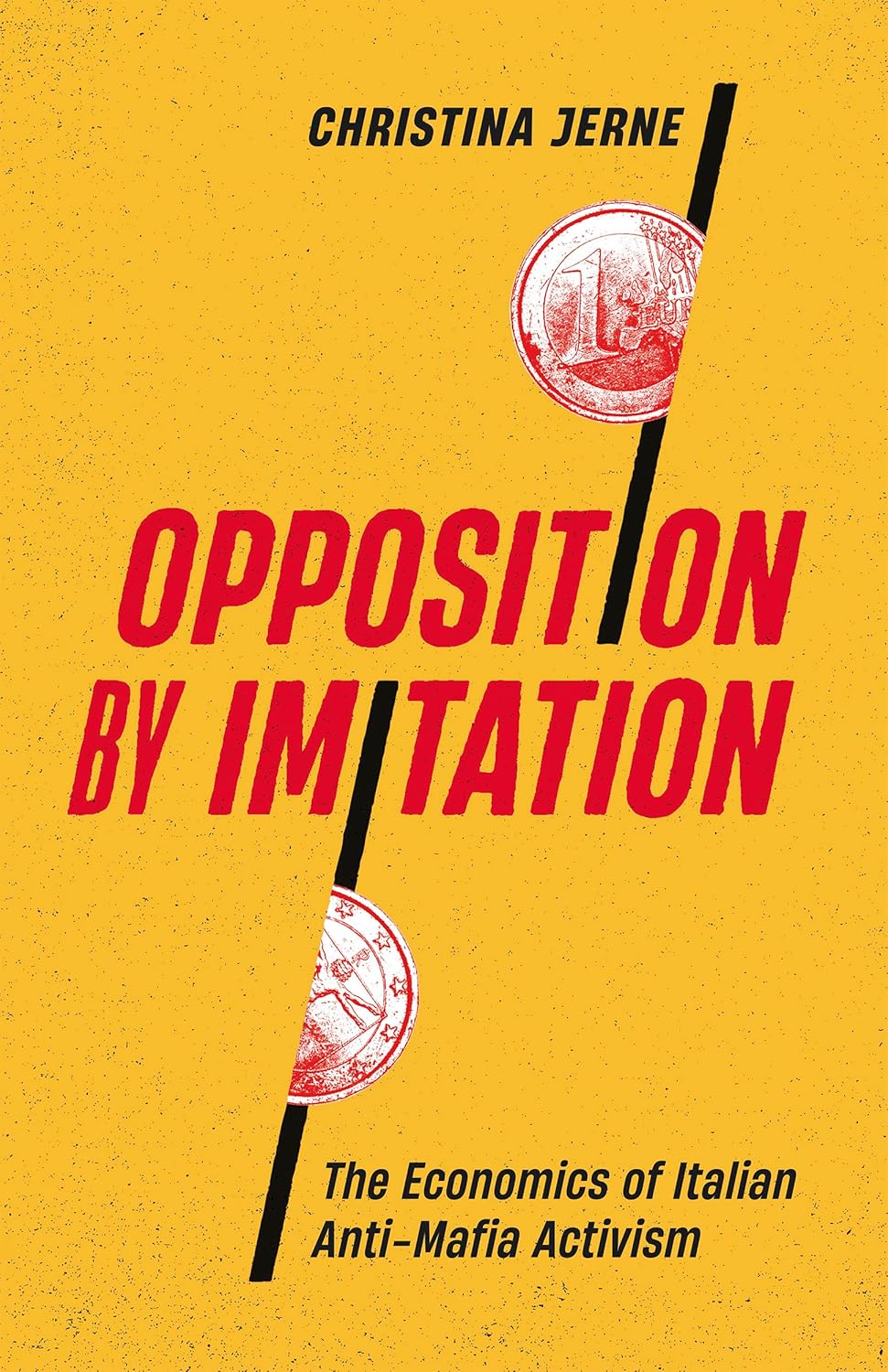
My new book Opposition by Imitation explores these forms of economic activism. Drawing on the ethnographic fieldwork I carried out in different parts of Italy between 2014 and 2019, it illustrates how ordinary people are organizing to prevent and counter the expansion of mafias, in the hope that others in other contexts might learn from these experiences. The analytical focus of the book is the anti-mafia movement’s tactic of mimicking the mafia. I am interested in the political possibilities afforded by this particular form of opposition, as well as the implications this mimetic relationship might have for broader questions of crime prevention and criminalization. This mimetic opposition has been increasingly articulated in economic terms. Not only is this interesting in and of itself, but this shift in repertoire opens broader questions about the forms in which collective action is most commonly conceived of and practiced.
Anti-mafia activists are not alone in turning to critical economic organization to counter injustices: slow-living movements challenging racial, class, and interspecies oppression inherent in industrial production models (Hersey 2022); fair-trade enterprises improving social equality along supply chains (Naylor 2019); African diasporas organizing alternative forms of banking to contest the exclusion and racism faced in dominant market economies (Hossein 2016); permaculture and veganism as reactions to environmental degradation. All these movements express their discontent by challenging business-as-usual models by owning up to their own economic agency.
This economic turn led me to seek out literature that would help make sense of what I was observing. Why were these activists experimenting with economic strategies? Was it a broader trend within contemporary collective action? The most obvious starting point to answer these questions was the field of political economy. However, its prevalently institutional take on politics pushed me to look elsewhere: literature on social movements and collective action. I soon found that although numerous studies were being undertaken on collective action that was manifesting some form of dissent toward economic matters, there seemed to be an essential dualism between the economy and politics. The economy, in other words, is often treated as something outside politics: a monolith that travels on a track parallel to politics.
On the one hand, it is discussed as something that allows grassroots politics to happen. In this understanding, economy means, for example, the financial resources needed to mobilize activists or to achieve visibility and access to arenas where lobbying activities can occur. We can call this the “instrumental rational action” paradigm, which is a mixed legacy of Habermas (1987) and utilitarianism, in the guise of new institutional economics (Olson 1965). In this case the social movement is envisioned as a rational economic actor, seeking to optimize its marginal utility, implying a broader colonization of politics with utilitarian logics. On the other hand, economy is framed as something that needs to be contested by politics. Unequal wealth distribution, privatization, or structural class issues, for example, would be seen as economic questions that need to be tackled by unions and other institutions where political power resides. The social movement is here usually a victim of an inescapable economic system, and its agency is reduced to its capacity to mobilize, to publicly manifest its claims to the true holders of power, usually state institutions. We can call this the “neoliberal diagnosis,” which is, not unlike the previous model, particularly prominent in radical leftist scholarship, and is a residue of Marxian essentialism, which conflates “the economy” with a unified, complete, and totalizing capitalist system that must be opposed.
In sum, both approaches separate the two realms, politics and economy, by placing them in a hierarchical position to one another. In neither version is economic action seen as having constitutive effects in its own right: it is either instrumental to politics (below it), or the object of politics (above it). But how can we talk of economic actions that are, in themselves, political without limiting ourselves to either one of these directions?
If the economy is “the social site that constrains activities at all other sites, the supreme being whose dictates must unquestioningly be obeyed” (Gibson-Graham 2006, 94) then it would impossible for ordinary people to change or contest any economic order. Yet the protagonists of this book demonstrate that there are many people (who are neither enlightened economists nor politicians) who are indeed contesting oppressive economic orders by taking matters into their own hands, recognizing that they too are economic subjects who are indeed capable of changing how they act.
Opposition by Imitation: The Economics of Italian Anti-Mafia Activism illustrates the different subjectivities and forms of agency involved in economic action and sets out to rethink the scope of cultural and political transformation that economic action can (and already does) bring about.
References:
dalla Chiesa, Nando. 2024. “Introduction: Mafia and Anti-mafia: A History to Fill.” In Against the Mafia: The Classic Italian Writings, edited by Nando dalla Chiesa and Christina Jerne, translated by Christina Jerne. London: Palgrave Macmillan.
Gibson-Graham, J.K. (1996) 2006. The End of Capitalism (As We Knew It): A Feminist Critique of Political Economy. Minneapolis. Minnesota University Press.
Habermas, Jurgen. 1987. Theory of Communicative Action, Vol. 2: Lifeworld and System: A Critique of Functionalist Reason. Cambridge: Polity.
Hersey, Tricia. 2022. Rest Is Resistance: A Manifesto. Little Brown Spark.
Hossein, Caroline S. 2016. Politicized Microfinance: Money, Power and Violence in the Black Americas. Toronto: University of Toronto Press.
Naylor, Lindsay. 2019. Fair Trade Rebels: Coffee Production and Struggles for Autonomy in Chiapas. Minneapolis: Minnesota University Press.
Olson, Mancur. 1965. The Logic of Collective Action: Public Goods and the Theory of Groups. Cambridge: Harvard University Press.
———–
* Christina Jerne is associate professor in Experience Economy at the School of Communication and Culture, Aarhus University, Denmark. This blog post is based on her recent book Opposition by Imitation: The Economics of Italian Anti-Mafia Activism (Minnesota University Press, 2025). Professor Jerne is also coeditor and translator of Against the Mafia: The Classic Italian Writings.
***
Since you find value in the content and resources shared by the ES/PE community, please consider making a contribution to help sustain our work. Your support is vital to maintaining our independence and carrying forward our mission. Intellectual and civic solidarity matters now more than ever. Every contribution makes a meaningful difference and helps ensure the continuation of accessible scholarship and useful information. Donate securely now via this PayPal link. Thank you!
Discover more from Economic Sociology & Political Economy
Subscribe to get the latest posts sent to your email.

What seems missing in Christina Jerne’s description of Mafias is their analogy to the de facto ruling class of what Nel Bonilla describes as the “Selectors”, the 1% billionaire clans – only interested in more wealth and more power- and their organizations selecting those politicians who will be organized to win the elections. The politics of these selectors, applied through the politicians that are to serve them, go – as one could easily observe- against the needs and interests of the people, the electors, justice, full-employment, welfare, civil services, peace, … . To serve their interests post-WW2 welfare states have systematically been dismantled via the creation of supra-national institutes that escape democratic control. As there are: central banks, IMF, the European Union, the International Court of Human Rights, World Health Organization, etc. In the context of these hollowing out of democracy and peoples welfare by the “legal” billionaire clans – owners of international banks, dito insurance companies military industrial enterprises, … – the “illegal” billionaire clans, the mafias and their organizations discovered a far more efficient and obvious way to get people appreciate them: doing what the democratic governments of the welfare states did before the abolishment of Glass-Seagal legislation and the like in the USA and the Maastricht Treaty in Europe. BRICS is at the geopolitical level something similar.
Richard van Egdom
richard@stiltehuis-pyreneeen.org
LikeLiked by 1 person