by Noam Yuran*
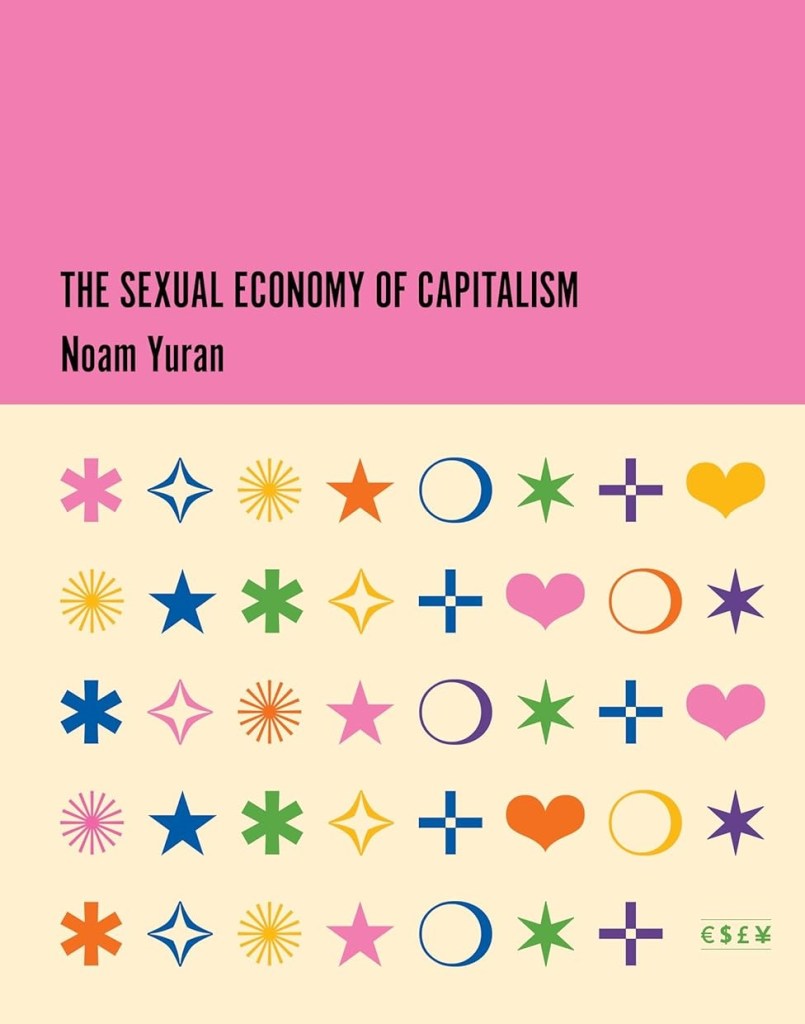
I noticed that when people see the title of my new book The Sexual Economy of Capitalism, they automatically assume that it is about the way capitalism shapes our most intimate spheres: how market relations permeate emotions, love life, sexuality and marriage. In fact, the book follows the opposite path. It is not an attempt to understand the reshaping of sexuality in capitalism, but an attempt to understand capitalism by viewing it from the perspective of the strange economy of sex. Marriage, prostitution and in some cases even love have economic aspects. These aspects are radically different from the mainstream view of the market economy. They are, however, a secret code of capitalist economy as such.
Why should we understand capitalism from this unusual perspective? A simple answer is enfolded in the history of monogamy. Traditional patriarchal monogamy was both a property regime and a sexual regime, without any tension between the two dimensions. In traditional societies marriage was conceived as an exchange, and wives were, directly or indirectly, their husbands’ property. All of this changed with the parallel progress of liberalism and capitalism. Yet, monogamy persists. In a sense, we inhabit it as a remnant of a lost past. Feminism has taught us the multiple forms in which ownership of women is still encoded in our notions of marriage and gender relations. To mention just a few names, Shulamith Firestone, Andrea Dworkin, Arlie Hochschild and Betty Fridan have shown how ownership is expressed in romantic love, in notions and fantasies of sex, in the distribution of emotion labor within the household and more. My book takes this as a starting point for a theoretical economic inquiry. Since ownership is a fundamental economic concept, it must have changed dramatically with the formal exclusion of wives from it. Ownership that encompasses women and things (as in traditional patriarchal societies) is not the same phenomenon as ownership that encompasses only things (as economics erroneously believes). Both are different from ownership that formally includes only things but informally also women – which as feminism taught us is its capitalist version. Liberalism and capitalism have not banished patriarchy but have only given it a new form, in what Carole Pateman calls “modern patriarchy”. The question that is left unanswered is what the stakes of this transformation for economic theory are. What kind of theory – and it is certainly not mainstream economics – can account for capitalism? In this sense The Sexual Economy of Capitalism is not a theory about the special domain of sexuality in capitalism, but an economic theory of capitalism grounded on the economy of sex.
The persistence of monogamy beyond its traditional form requires parting with some deep-rooted misconceptions about capitalism. It is customary to say that in capitalist societies market relations permeate all spheres of life, including the most intimate ones. In truth, capitalism should be defined by the formal exclusion of marriage from the sphere of exchange. An economy where everything is susceptible to exchange is in truth closer to what anthropologists call primitive economy. Capitalism, by comparison, should be conceptualized through a unique topology, where the family stands for an external-inside of the economy: external to the market yet internal to the economy. It is also customary to see money as a leveler, a medium that erases qualitative differences and sustains a universal web of equivalence. In truth, money in capitalism is an obscene object that upsets the possibilities of equivalence and calculation. That is the meaning of the cliché that in capitalism everything has a price. In a literal reading it indeed refers to the levelling powers of money and to the expansion of market logic. The force of this cliché, however, lies in its obscene undertone. And this obscene undertone means precisely the opposite: that capitalist economy is not identical with the capitalist market. It refers to what money should not buy yet is suspected of acquiring. It means that money is associated with things that it cannot or should not buy through non-market relations.
The obscenity of capitalist money is brought to the fore in prostitution. In parallel with the change in the economic status of marriage, prostitution went through a transparent yet radical permutation. Prostitution was abhorred before capitalism, and it is still abhorred. The popular relation to it expressed, and still expresses, a misogynist anxiety over female sexuality. Yet the grounds for its abhorrence have changed. In pre-capitalist societies prostitution was condemned as part of sexual ethics. It was grouped together with fornication and adultery, as illicit sexual conduct. Capitalist societies are much more liberal in their sexual ethics. Adultery and fornication are no longer clear moral categories. Yet prostitution is still abhorred, but what is abhorred in it today has to do with money. It is no longer the sexual act that is abhorred but the monetary exchange involved. The obscenity of prostitution today is the obscenity of money, and for that reason, a proper understanding of capitalist money should include its relation to prostitution.
Money also informs of the male experience of prostitution. Catherine MacKinnon argues that prostitution abuse is not about sexual pleasure but about domination of women, articulated through sex. What male clients want is not just sexual pleasure but “you-do-what-I-say sex”. MacKinnon uses a peculiar formulation for this pleasure: men in prostitution “pay for paid sex”. Read literally, this phrase suggests that the male pleasure in prostitution is monetary: a consummation of the universal power of money, its power to buy everything, including sex. Notice the economy in MacKinnon’s formulation. It diverges from the most fundamental concepts of mainstream economics, because money appears in it on both sides of the exchange. It is not simply paid for something, but also change the nature of the thing paid for. While this is an aberration in relation to economic theory, it is much closer to the rule of capitalist reality. Whenever we buy an expressly expensive thing we pay for a “paid X”.
Marriage and prostitution are two aspects of the same topology of capitalism, where gender relations are excluded from the market yet belong to the economy. Marriage is still an important economic institution, but it must not appear as such. It should be motivated by love rather than by practical considerations. Indeed, it is in capitalism that prostitution, to quote Simone de Beauvoir, “is a shadow that accompanies marriage”. Between the two, the capitalist market takes shape. The exclusion of marriage from the sphere of exchange is part of what rendered this traditionally venerable human activity despicable, as expressed in the shadow of marriage within the market.
How can this topology be the ground for an economic theory? The book‘s answer is that capitalist economy is organized around what money cannot buy. In capitalism what money cannot buy must be understood as an economic category. It is positively expressed in various ways in economic life. It informs economic motivations and behavior (e.g. a ceaseless pursuit of profit is not aimed at more money but at more than money), it distinguishes capitalist money from its earlier forms, and it is even inscribed on the goods that money buys (e.g. branding, as a rule, promises something that money can’t buy). A comparison with feudal economy clarifies the unique place of economic category in capitalism. Feudal economy was also organized around what money could not buy, namely land and the associated class status. In feudalism, however, this category was a real limitation on the power of money. In capitalism, by contrast, what money can’t buy is a porous limit. It denotes the mode of expansion of money to all spheres of life. There are things that money cannot or should not buy, yet maybe it buys them or suspected in buying them. Maybe it acquires them without buying. Maybe it buys a substitute. A simple look at advertising clarifies this. Judging from advertising, capitalism is an economy where wives are not owned, yet everything one buys is a woman.
To develop the theory, the book turns to the history of economic thought. My approach to this history is thoroughly biased: what economics has forgotten while taking the shape of a scientific discipline is more important than what it has kept. Five economic thinkers form the theoretical core of the argument: Marx, Veblen, Mandeville, Sombart and Weber. Common to them is a historical outlook, which is a necessary requirement if one is to develop an economic theory which is unique to capitalism. In parallel, their works gesture in different ways at the category of what money can’t buy. It is rarely mentioned as such, but it can be read into their works, and it marks the outline of an economic theory radically different from economics. In place of notions of equilibrium, money that is related to what it can’t buy puts the economy off balance. It marks an economy suspended between two contradictory principles of needs and desires. It subverts the hierarchy between luxuries and necessities and permeates goods rather than being an external medium for their exchange and valuation. In some rare occasions, what money can’t buy is mentioned within the canonical tradition. When Adam Smith and Alfred Marshall invoke it, it denotes an exception to their theories. In these exceptions, I argue, they come closest to understanding capitalism.
The book comprises six chapters. The first chapter presents the unique topology of capitalism, and the concepts required to theorize it. The second chapter addresses sex in the history of economic thought. Its starting point is the weird beginning of modern economic thought. Bernard Mandeville’s Fable of the Bees, one of the obscenest economic texts, is populated with prostitutes, mistresses, husbands and wives. Adam Smith’s prudish rewriting of Mandeville’s theory replaced them with artisans and shopkeepers. The chapter shows that the replacement is not just a matter of writing style. A complete transformation of the concept of economy is enfolded in it. Chapter three addresses marriage. It inquires how economy takes a new shape when marriage is not conceived in terms of exchange but motivated by love. Chapter four discusses prostitution. It inquires what are the economic theoretical stakes in the sex work controversy. It presents prostitution abuse as a monetary experience and explores the logic of the cultural association between prostitution and finance. Chapter five addresses the eroticization of consumption throughout the twentieth century. Regarding the nineteenth century, the sexual economy of capitalism is most easily discernible. One only needs to read a realist novel by Zola, Balzac, Trollope, or Wharton to see its contours. During the twentieth century it became less visible but not because it dissolved. Rather, it lost its specific locales and expanded to the whole economy. On the sexual side, the tension between love and marriage has disappeared. On the economic side, the distinction between luxuries, as eroticized goods, and necessities has become blurred. The chapter shows how eroticization has spread over the whole of consumption. Chapter six completes the view of the previous one by turning attention from the economy to sex. It shows how the logic of capital informs contemporary sexual culture, in pornography, dating, the hook-up scene and more.
—————–
* Noam Yuran is Senior Lecturer in the Graduate Program in Science, Technology and Society at Bar-Ilan University. He is the author of What Money Wants: An Economy of Desire (Stanford, 2014)
***
While you enjoy and benefit from the ES/PE community’s contents and useful information, please consider making a donation to endorse our work. Your contribution will ensure the ES/PE community’s independence and sustain our mission. No amount is too small to support. Donate safely via this PayPal link. Thank you!
Discover more from Economic Sociology & Political Economy
Subscribe to get the latest posts sent to your email.

“In truth, capitalism should be defined by the formal exclusion of marriage from the sphere of exchange.” I know we like to pretend this is true, but just because women have more freedom of choice in marriage doesn’t mean it has nothing to do with the “sphere of exchange.” In most of the United States, women had very few means of economic independence until the 1970s; they couldn’t get a bank account without a man signing off on it, even if they had jobs. And now having a family without two incomes is increasingly difficult, so again, women are, in a subtle way, blackmailed into marrying somebody, just no one specific.
LikeLike
I read about an attempted study at Columbia University where they tried to discern the difference between men who monetized intimate behavior and men who didn’t, but they couldn’t find enough men in NYC who’d never been to a strip club to form a statistically valid sample.
LikeLike