by Andrea Maurer*
This article showcases the development of economic sociology and the vibrant activities and achievements within the Economic Sociology Research Network at the European Sociological Association. Even though the development has not been continuous, there has been a successful rediscovery of economic topics in sociology. The accomplishments have allowed the Network to have a rising influence and to play an active part in the field of European sociology.
1. Background
Today, many sociologists have a sceptical or at least ambivalent view of the economy as well as of economic thinking. Although there is some air of scepticism or ambivalence towards economic issues in sociology, these topics are essential to our modern world. Moreover, there is a long tradition of a social science perspective on the modern capitalist economy. Some sociological classics have outlined an approach which relates the modern capitalist economy to social, political and cultural factors. Unfortunately, these broader perspectives were lost shortly after the institutionalisation of sociology.
As we all know, these early European-based attempts to explain and analyse the rise of modern capitalism by combining economic and sociological factors, methods, tools and perspectives ended abruptly due to political and theoretical changes in the 1930s. In the following period, neoclassical thinking became the mainstream line in economic theory and sociologists have repeatedly found themselves in disagreement with mainstream economists. Sociologists and economists parted ways, moving in different directions. As a result, many sociologists stepped completely away from analysing the economy and economists focused on market coordination, isolated from society. In the end, this strategy narrowed the view on the economy and removed the economy from the sociological agenda for an extended period of time.
This article outlines the development of economic sociology since the 1970s and how the ESA “Economic Sociology” Research Network has contributed to that development related to European sociology in more recent times. It reconstructs the line of development with its highs and lows and sheds light on the importance of the restart in the 1970s when some sociologists in the US as well as in Europe started thinking about the relationship between economic and sociological theory and working on broader explanations of the modern economy in order to overcome the shortcomings of the dominant approaches at that time, which studied the economy in isolation. These are the seeds of what we have today in our Network along with the influence it enjoys nowadays.
2. Bringing economic topics back into sociology
The term “New Economic Sociology” was coined, being linked to the notion of “social embeddedness” in order to define a new authentic sociological perspective on the modern economy. This New Economic Sociology was explicitly established as a subdiscipline of sociology aiming for a broader view on central economic topics from the 1970s onward. New Economic Sociology started quite successfully, based on the idea that social constellations or social factors frame economic action and exchange relations, in contrast to mainstream sociology as well as standard economics. New Economic Sociology research began to focus on the social embeddedness of markets, firms, branches and regions and provided models about how various social forms support economic action and exchange relations. Some proponents of New Economic Sociology also considered the emergence of particular economic institutions and institutional forms important factors for economic and societal performance. Currently, we can differentiate one line which concentrated on how social factors work as a social capital for rational-intentional actors and another line which highlighted how social factors shape the actions of individuals. Both analysed and empirically studied how social factors influence economic action and exchange relations and, in the end, economic performance. This served as preparation for outlining New Economic Sociology as a research programme that explicitly connects theory and practice, providing an alternative view on the economy distinct from both mainstream sociology and price-oriented economic analyses. The central figures of New Economic Sociology like Mark Granovetter (1982), James Coleman (1990), Richard Swedberg (1994) and Ronald Burt (1982), to mention a few, took sociological analyses to a new level. They have planted the seeds for us to currently rethink explanatory theories and reconsider theorising in sociology. This was the basis for working on more realistic explanations on economic topics.
Today, we stand on the shoulders of the classics as well as of those sociologists who rediscovered the modern economy as a sociological topic, emphasising concepts and models that focus on social relations interdependencies in the economy (Granovetter 1985; Smelser and Swedberg 2005). Based on this, providing a more realistic perspective on the market economy that explores how social factors frame and support economic action and relations became central for economic sociologists.
The awakening of economic sociology was linked to more general debates about theorising and how to construct sociological explanations in the international field. In this framework, markets were conceptualised and analysed focusing on social factors such as networks or institutions. As a result, sociologists began to work on concepts, models and studies that showed how and why social factors help individuals to handle various issues in the market economy as well as in society. Thus, economic sociologists started to contribute to the theorising concerning social relations, groups, markets as well as organisations. By doing so, they explored the mechanisms that come with those social forms such as trust, control, competition and loyalty to name a few. We still refer to those basic concepts and empirical insights when asking what effects coordination forms come with and why markets sometimes fail. This allowed us to avoid an overemphasis of both markets and hierarchies, but rather highlight more complex and alternative coordination forms. Those insights have made economic sociology an important contributor to economic analyses as well as to sociology. It has opened the view to include different coordination forms and their rise and functioning, thus creating a new research field.
Most of all, the core programe of New Economic Sociology was based on a theory-practice link, which defines the concepts of social embeddedness or social capital as a foundational framework that over the last century led to a coherent research program, integrating researchers and topics. It was only in the twenty-first century when newcomers from diverse backgrounds entered the field and added different perspectives that, in the end, might weaken and change the core programe. In this sense, the newcomers often stand for a different theory-practice link, one that wants to strengthen societal principles and logics. Since then, the question has often been raised concerning what economic sociology is nowadays. On the one hand, the newcomers widened the perspective and introduced new topics like that of culture and meaning as well as performativity. On the other hand, they criticised New Economic Sociology for being too restricted or having been built on a “shaky foundation” (Zelizer 2011). This changed the perspective of economic sociologists and came with new lines of thinking such as ethics and morale (Fourcade and Healy 2007). This also moved researchers in the direction of evaluating the economy from a societal perspective and interpreting economic institutions and structures more in the light of societal or cultural principles and beliefs. Political issues have also received more attention since then. As a result, collectivistic normative principles returned, which then also questioned resource efficiency and criticised economic performance as dominant design principles.
In general, New Economic Sociology laid the groundwork for establishing an international research field, dealing with economic topics from a broad social scientific perspective and making sociology relevant to the study of the economy. Since then, sociologists have been concerned about more realistic explanations of the modern economy. And economic sociologists have conducted empirical studies that provide evidence of the effects of social factors on the economy and have rediscovered the central goal of providing scientific knowledge for designing the modern economy.
Economic sociology has developed step by step starting with the classics over the founders of New Economic Sociology in the 1970s and 1980s to sociologists of different backgrounds coming from all over Europe and the whole world nowadays. European sociologists and members of our network are doing cutting-edge research nowadays. Even though a sociology of the economy has been reinvented and developed quite successfully in the last 50 decades as an international endeavour, it now stands at a crossroads. Again, sociologists interested in economic topics need to clarify its methodological framework, its theoretical tools and its aim(s) to elaborate how theory links to practice.
3. The development of the Network: the last decade of achievements
It comes as no surprise that all over the world, economic sociological associations have been re-established, rebuilt and reactivated from the 1970s and 1980s. The “Economic Sociology” Research Network at the European Sociological Association was established by Richard Swedberg (Sweden/USA) and Gyorgy Lengyel (Hungary) in 1995. Although the start was promising, there were also political and theoretical obstacles that needed to be dealt with such as the enlargement of Europe, the shortcomings of dominant approaches and the clash of different theoretical traditions in the 1990s. An important turning point in the formation of the Economic Sociology scientific community was the ESA conference in Prague in 2015. At that time, some new members joined the network and began to integrate different traditions, work more intensely on the improvement of theory, link to the international community and build a scientific identity for the network in the end. Since then, the network has increased in membership, activities and attractiveness. Conferences and meetings have flourished in both quantity and quality. Built on a joint session organized at the ESA conference in Prague, in 2017 the coordinator Sebastian Koos together with Triin Vihalemm and Margit Keller edited a special issue in International Journal of Consumer Studies on “Crises and Consumption”.
Important milestones were the mid-term conference in Madrid (Spain) in 2016 hosted by Alberto Ramos-Veira dealing with “Squaring the Circle: Integrating Theories and Empirical Analyses in Economic Sociology” and the 2018 mid-term conference in Konstanz (Germany) organised by Sebastian Koos focusing on “Economic Sociology and its Intersections”. The last mid-term conferences in Warsaw (2022) and in Firenze (2023) had specific focuses and allowed speakers and participants to discuss relevant topics more thoroughly. The organisers Mikolaj Pawlak (Warsaw, Poland) and Giacomo Bazzani (Firenze, Italy), experimented with new forms and organised social events, which made both mid-term conferences a success. The one in Warsaw highlighted “Categories, Transformations and Exchanges” while the focus in Firenze was on “European Societies in Transition”. All these mid-term conferences were hosted by members of the network in cooperation with the coordinators. They attracted many young as well as experienced researchers from all over Europe. Researchers from outside the EU – the US, Israel, and Brazil to mention a few – began to attend mid-term conferences, becoming interested in the network and joining us as members.
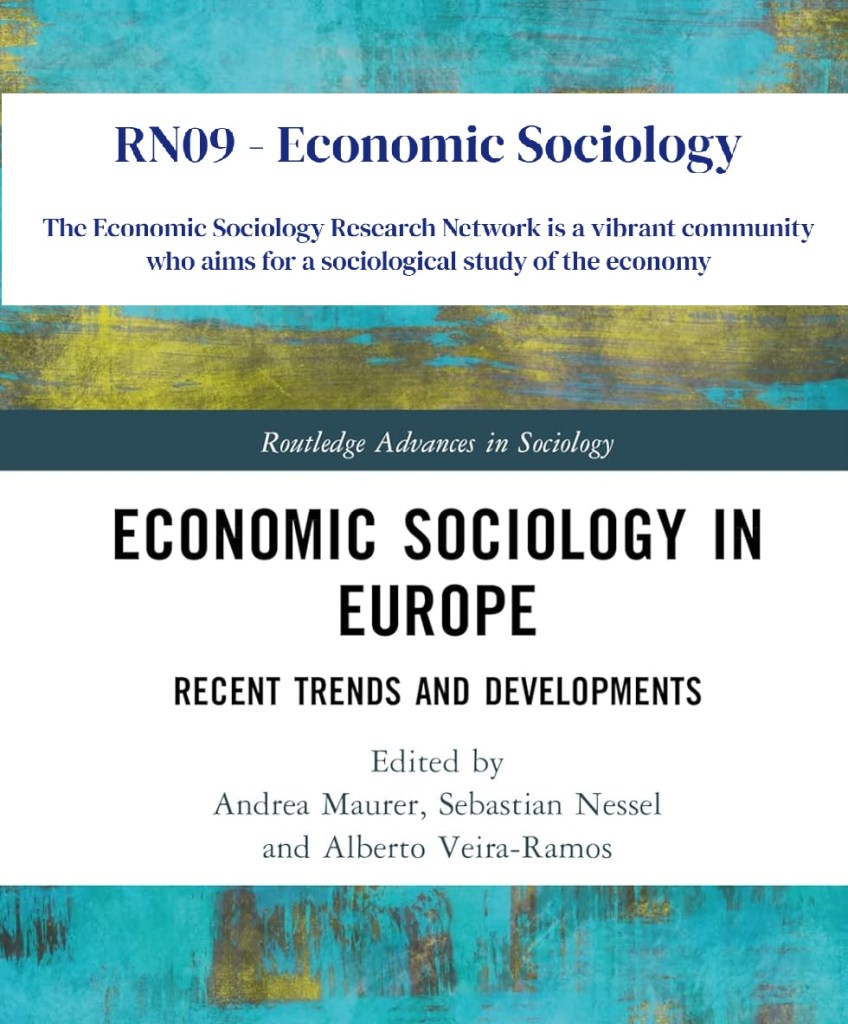
Online and hybrid formats of meetings and conferences, even during the pandemic, allowed us to move forward with meeting and exchanging ideas. Our network was able to effectively use these digital options, although they were new to most. One inspiring and successful experience was the ESA Conference in 2021. It was to be held in Barcelona in person but was held virtually due to the pandemic. Our Network organised and hosted nearly 80 sessions, covering theoretical and empirical studies as well as presentations addressing contemporary issues such as how the multiple crises were being faced throughout Europe. The network coordinators selected some presentations from this conference and compiled a book Economic Sociology in Europe (2024), whose chapters have undergone a complex review to ensure high quality. The collected volume covered studies on markets, societal and political institutions as well as on crises from an economic sociological perspective. The chapters highlighted current lines of thinking in European sociology and at the same time reflected the interrelationship with US economic sociology.
Those meetings also were springboards for exchanging ideas, creating interaction as well as building an identity for us as economic sociologists. They also became important for introducing new topics and methods that are currently extremely relevant for analysing present challenges in European societies and economies such as comparative institutional analyses or case studies. One of the most exciting new topics economic sociologists started dealing with were economic crises, war and violence as well as digitalisation. These new concepts and studies have been conducted in different European countries and showed how different regions and countries have dealt with those challenges and how this changed international as well as local labour markets, social structure, social institutions and well-being throughout Europe. One of the most exciting perspectives which emerged was analysing how economic, social and political crises are handled differently in European countries and how these crises change the economy and influence our understanding of market capitalism.
4. Achievements
The ESA Economic Sociology Research Network has been building a vibrant, global community over the last ten years, including researchers from Israel, India, Brazil and the US. It created an identity of economic sociologists based in Europe by focusing on current theoretical and empirical developments in Europe and especially by researching how European countries have dealt with crises such as the Corona pandemic or the war in Ukraine in recent years. Some of our members provided deeper insights into how much the pandemic has changed economic and social relations as well as material and social well-being. Changes in the labour markets were one of the most interesting focuses of a number of studies. Other members restarted thinking about the war economy and economic nationalism. We did this in an open-minded way, being quite innovative when it comes to methods and theory. We elaborated on how social constellations shaped economic processes and vice-versa.
The Research Network has been involved in a number of important projects. Economic Sociology in Europe, edited by Maurer, Nessel, and Veira-Ramos (2024), is a display of how to improve sociological theory, how to use and develop empirical methods and how to conduct comparative research with a focus on Europe.
Our conferences and sessions hosted during the ESA conferences have seen higher attendance, reaching a wider range of researchers in terms of experience and location over the last decade. Our members have been able to publish more works, both writing and editing publications, even in European sociological journals such as European Societies and The European Sociologist, giving us more visibility in the global field.
We have had more members with an active role in the European Sociological Association. Members of our network were on the editorial board of European Societies and at the ESA executive committee. Some were nominated as candidates for the executive committee, while others were active members of national sociological associations.
This has increased our relevance to the institutional and organisational work of European sociology as well as to the scientific area in academia in various European countries and associations.
5. Influence on and contributions to European Sociology and beyond
Our Research Network has seen our influence grow steadily since the ESA conference in Prague in 2015. We have been able to develop new lines of thinking on the economy and bring new topics to the field of sociology and economic sociology. By doing so, we have been able to bring European Economic Sociology to the forefront of the global research field. In some ways, economic sociologists have stepped out of the shadow of the predominant tradition by advancing methodological tools as well as by introducing new theoretical concepts and methods. In the first case, we contributed to the debate on action-structure links and wider action models. In the second case, European classics as well as European lines of thinking have been adopted and developed in the field of economic analyses. This has led to some new branches in economic sociology that focus more on society and how societal principles are the base of and also enable the modern economy. As a result, a more societal and political perspective on the economy emerged, emphasising the negative side effects capitalism has on social relations, norms and principles.
Our Research Network has also seen our influence grow in the European sociological community since 2015. Not only has our network has been able to bring economic issues back into European as well as international sociology but it also brought them to the forefront of sociological research in general. We have been developing new theoretical tools and use other empirical methods to conduct studies on important current topics such as crises, climate change and how to deal with the challenges those issues present. Our members have worked with market studies in Europe, and with comparative studies about European economies, regions and branches. By doing so, classics such as Alfred Marshall, John Commons, Max Weber, Karl Polanyi and Albert Hirschman, to mention a few, have been rediscovered. In light of this, we are ready to rediscover the classic idea of a social scientific approach aiming for a realistic view on the modern economy, which takes society and culture into account and makes the economy an attractive research field for sociologists.
As a result, a social and scientific network has been created that is connected to other fields of sociology as well as to social science disciplines and various countries that, in the past, have been isolated like those of different European countries. Our research network has left some of the classical conflicts behind and has given space for new debates, new topics and other forms of collaboration across sociology and the social sciences. We see a revival of socio-economic ideas and concepts that help to bridge the gap between sociologists and economists. Additionally, we have been working intensely on outlining the limitations of market coordination and emphasising coordination forms such as hierarchy, networks and self-governance as an alternative or supplement to markets. In this sense, we all moved forward together and are looking for new projects.
All in all, even though the development of a sociology of the economy has not been continuous, we have been able to develop step by step. Thus, we hope for future collaboration within European sociology and with other research networks, national associations and disciplines of the social sciences to deal with the challenges of our global world. We believe that, in the last decade, our Research Network has found its voice in the European sociological orchestra.
——————-
* Andrea Maurer is the ESA Economic Sociology Network coordinator and Full Professor of Sociology at Trier University, Germany. Handbook of Economic Sociology for the 21st Century and Max Weber’s Sociological Thought on the Economy are her recent books, and her new book Economic Sociology will be published soon. This essay appears on behalf of the Network and its co-coordinators Giacomo Bazzani, Sebastian Nessel and Alberto Veira-Ramos. It was originally written for and published in The European Sociologist.
***
Feel free to share this post with your colleagues, students and friends.
Follow Economic Sociology & Political Economy community on
Facebook / X / LinkedIn / Whatsapp / Instagram / Tumblr
Telegram / Threads / Mastodon
Discover more from Economic Sociology & Political Economy
Subscribe to get the latest posts sent to your email.
