by Jean-Louis Laville*
Two major lessons emerge from the 19th and 20th centuries. Firstly, the promotion of a market society underpinned by a concern for individual freedom has increased inequality; secondly, the subjugation of the economy to political will under the pretext of equality has led to the suppression of freedoms. These two solutions have thus come to challenge democracy. Not only is this what totalitarian systems wanted; it is also what, in another way, the subordination of political power to that of money leads to. Consequently, a key question in this beginning of 21st century is how to reorganize the relationships between economy and society in a new way, both protecting and emancipatory. This is why sociologic economy and political economy are so important now days because they study the links between economy and society by combining in different ways economic analyses with other social sciences.
As it is regularly mentioned in this blog — by authors like Oleksandr Svitych, John Vail, Margaret Somers and Fred Block, Oleg Komlik, and others — among these heterodox approaches Karl Polanyi’s one is particularly relevant. To counter the fallacy, which corresponds to the formal definition of the economy, according to which scarcity determines the relationship between means and ends, Polanyi gives a substantive definition of the economy. This definition recognizes our dependence on nature and on our fellow human beings and holds that the satisfaction of human needs requires institutional interaction. It replaces the focus on the market with an openness to the plurality of principles of economic integration including redistribution, reciprocity, householding.
Redistribution is the principle according to which a central authority is responsible for allocating what is produced, which presupposes procedures defining the rules of levy and their use. Reciprocity corresponds to relations established between groups or persons through actions that only make sense insofar as they express a will to demonstrate a social link among the stakeholders. Householding concerns the basic group in the society under consideration (the oikos, the domestic household, the nuclear family, etc.).
Through its critique of positions that reduce the economy to the formal economy, substantive economics joins up with bio economics and ecological economics, which blame these formalist positions for introducing a complete rupture between the economy and the living. In formal economics, both labor and land are equated to commodities, which is untenable from the point of view of both human and non-human beings. This extractivist way of thinking – for which these beings are only human or natural resources – denies the interdependencies of life.
On an epistemological level, substantive economics also converges with feminist analyses that question the reductionism of formal economics, which values production and neglects reproduction. Taking up the discussion of care, economists like Carasco, Federici, Gibson-Graham and Nelson have criticized this view, which disregard the activities of provisioning, whose purpose is not profit but rather the preservation of life and the concern for wellbeing. They argue that to reintegrate the dimensions of race and gender into the economy, it is crucial to consider all forms of production and reproduction – those that make room for monetary flows as well as those that occur through non-monetary flows.
The actual crises therefore raise the question of which institutions are able to ensure the pluralization of the economy in order to embed it in a democratic framework – a framework that the logic of material gain compromises when it no longer encounters limits. We must look to institutional inventions rooted in social practices for the answer; it is these that can show us how to re-embed the economy in democratic norms. We need to draw on these practices and analyze them. For example, there are solidarity initiatives created by women all over the world like the people’s canteens in South America and West Africa, the local food networks in Senegal, the collective kitchens in Peru, the Women’s Self Employment Association in India, and so on (see Verschuur, Guérin and Hillenkamp). In a certain way, these solidarity based self-organizations are not only emergences but resurgences of women’s movements coming from the 19th century as well as Black Lives Matter is related to other Afro-American civic movements, and many agro-ecological experiences from Via Campesina members are rooted in peasants resistances. But most of these memories have been largely forgotten.
The significance of the solidarity economy lies in the fact that it is a real economic movement and not a project of social reform that has been plastered over reality. There have been millions of associative, cooperative, mutual aid experiences intended to accompany the citizen’s search for a “good life”, to use Aristotle’s expression, or “buen vivir”, a concept adopted in the Andean countries. They contribute to the livelihood of men or to a human economy (see Hart, Laville and Cattani) but they have remained largely invisible, their history has been forgotten and the numerous emergences in the last decades have been ignored, due to the frontier established between economic and political spheres, between ideas and practices.
The analytical distinction between types of human activities underlined by Arendt and Habermas should not been turned into an empirical dichotomy; on close examinations of practices the separation in lived experience between politics and economics does not seem to exist. As I elaborate in my new book, the solidarity economy initiatives have indissociably a public dimension by their participative and deliberative orientations and productive as well as reproductive dimension because they search for the improvement of daily conditions.
Furthermore, the solidarity economy requires an approach in which ideas and practices are interwoven. The separation between “material” and “ideal” motivations has, in Polanyi’s view, produced disastrous consequences, hunger and profit being the only motives for the individual’s participation in economic life, (see Polanyi’s The Livelihood of Man). To counter the excesses of capital and to maintain eco-diversity – which is just as necessary to a living democratic society as bio-diversity – it is important to diversify forms of resistance, drawing on aspects of the real economy that are made invisible by its formal definition. This is why the solidarity economy, understood from a Polanyian perspective, can no longer be scorned or dismissed in thinking about emancipation. Democracy cannot be preserved without a democratization of economy. This democratization has already begun through civil society actors but, obsessed by the power of multinationals, we have not identified the phenomenon. It is crucial for the 21st century to recognize not only the social movements but also the any solidarity initiatives existing all over the world.
—————-
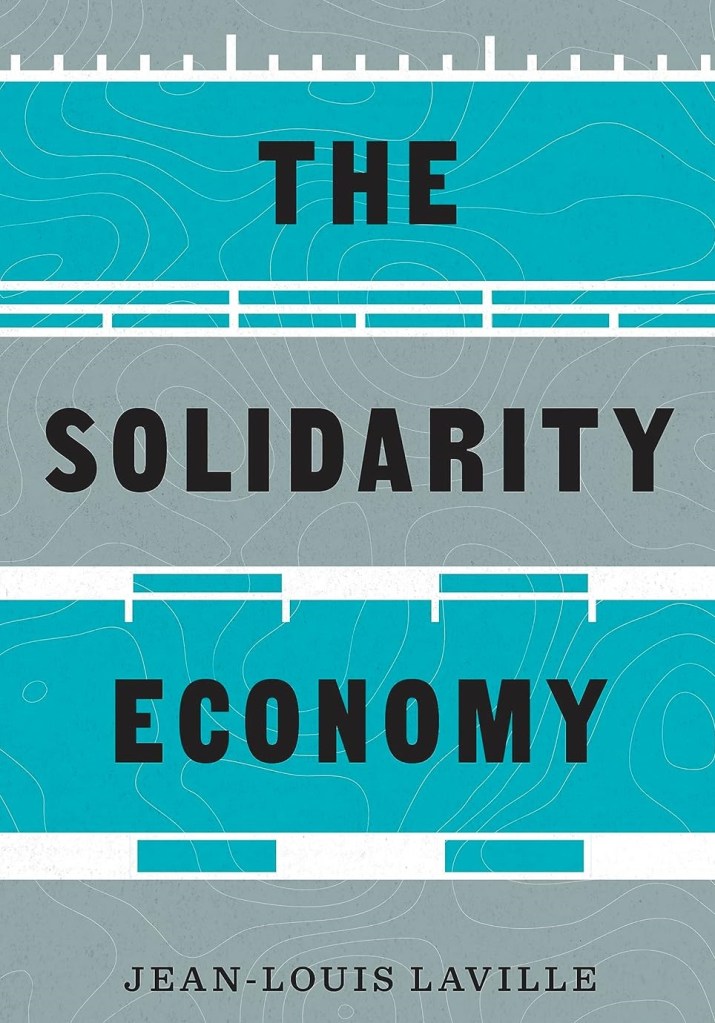
* Jean-Louis Laville is professor at the National Conservatory of Arts and Crafts in Paris, where he holds a Chair in Solidarity Economy. He is author and co-editor of several books, most recently The Solidarity Economy; Theory of Social Enterprise and Pluralism; Civil Society, the Third Sector, and Social Enterprise; and The Human Economy.
***
Feel free to share this post with your colleagues, students and friends.
Follow Economic Sociology & Political Economy community on
Facebook / Twitter / LinkedIn / Whatsapp / Instagram / Tumblr / Telegram / Threads
Discover more from Economic Sociology & Political Economy
Subscribe to get the latest posts sent to your email.

Very interesting
LikeLike
[…] century, worker-owned cooperatives demonstrated how economic practices could be directly “embedded” (to reference Polanyi) within the values and practices of solidarity. And it was this economic […]
LikeLike
[…] century, worker-owned cooperatives demonstrated how economic practices could be directly “embedded” within the values of solidarity. And these practices of economic cooperation, in turn, helped […]
LikeLike
[…] proprietà dei lavoratori dimostrarono come le pratiche economiche potessero essere direttamente «embedded» nei valori della solidarietà. E queste pratiche di cooperazione economica, a loro volta, hanno […]
LikeLike