
by Noé Kabouche*
Over the last few decades, initiatives involving ‘sustainable’, ‘ethical’ and ‘responsible’ finance have been thriving. Among this flourishing renewal of morality in the financial world, ‘impact investing’ is one of the last iterations of such attempts, continuously presented since 2007 as a revolutionary endeavor meant to achieve the not-so-easily-achievable effort of holding together economic profit and social & environmental impact. Its promoters, including the Rockefeller Foundation and some ‘high net worth individuals’, desperate to solve today’s ‘grand challenges’ not only promised to generate impact by investing, but also to make said impact concrete, measurable, tangible. Theorized by Emily Barman as one typical instance of ‘caring capitalism’, impact finance has been observed by academics as a multiform, plastic and boundary-blurring object reproducing larger trends of neoliberalization, market moralization—or, some would argue, marketization of morality—based on the accountability of the public good and its integration into financial schemes. Yet, when one looks at the existing literature on this matter, it becomes obvious that case studies of impact investment are greatly diverse, not least because they involve drastically different asset classes and financial instruments. This diversity is not ignored—but its circumstances, structures and patterns remain understudied, hence limiting our comprehension of the role(s) impact investing holds in finance moralization and financialization of the public good.
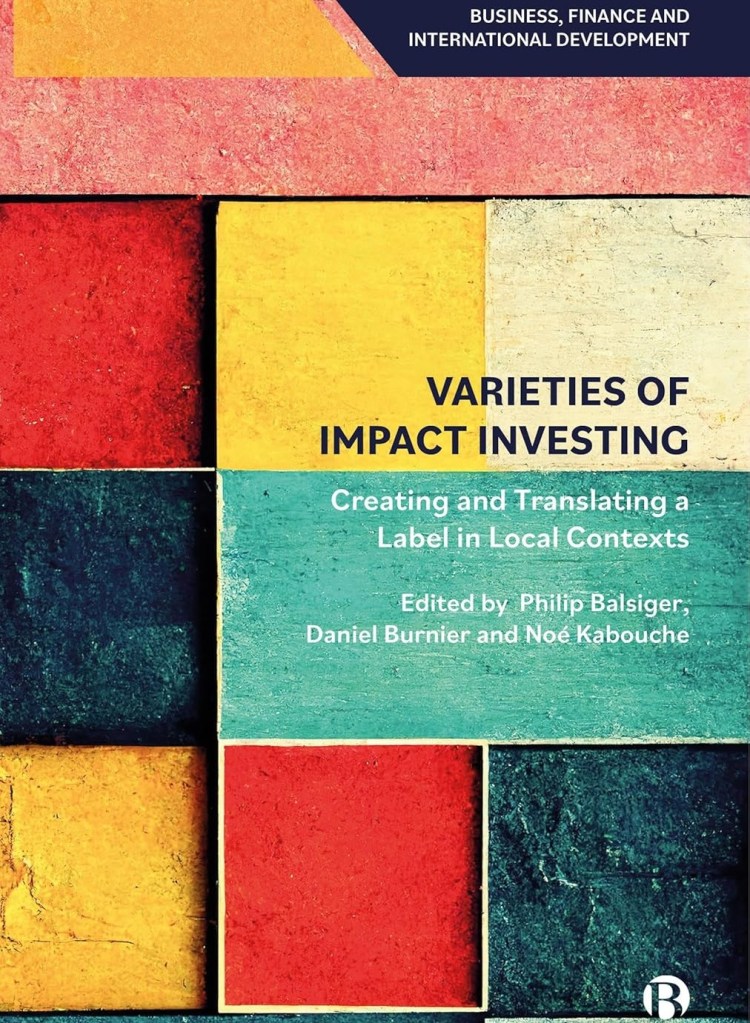
These observations emerged while organizing a conference on impact finance in Neuchâtel, Switzerland, in 2022, where scholars from various disciplines were invited to present their insights on this object, and who afterwards contributed to this book. Varieties of Impact Investing, edited by Philip Balsiger, Daniel Burnier, and Noé Kabouche, hence displays a collection of variegated case studies which highlight the effect of ‘contexts’ in impact investing development. While contexts largely refer to the locality of the implementation of financial practices, they also include the cultural, political and institutional arrangements which frame it. By studying this, we try to both understand what unites varied enactments under the same ‘impact investing’ category, and identify the contextual factors that shape it in so many different versions. The larger goal of this approach is to examine how the greater themes of impact finance (financialization, power dynamics, accountability and privatization of the public good…) which are usually tied to particular examples, can be understood as consistent patterns, taking different forms depending on the contextual specificities of their development. For this purpose, the book proceeds in two steps.
The first section is made of chapters examining how impact investing, as a label, is contextually translated. This part is particularly attentive to actors, institutions and processes that make its development contingent upon national and regional backgrounds. Based on the various examples detailed by the volume’s contributors, we argue that this label is usually mobilized in an instrumental manner, fit to acknowledge and encompass existing institutional structures. As a result, the label translation and success—or failure—strongly depend on institutional contexts. In a number of cases, impact investing is translated into categories that are already acknowledged by established actors, and hence benefits from related resources and imaginaries. It is therefore quite usual to see impact finance emerge as a relabeled form of older kinds of ethical finance, be it solidarity finance in France (Eve Chiapello & Camille Roth’s chapter) or microfinance in Geneva (Noé Kabouche’s chapter), before being re-assimilated and more largely spread through more conventional streams of finance. This pattern also exists in the realm of philanthropic and development organizations, as shown by Farwa Sial & Jessica Sklair, who demonstrate how the Aga Khan Development Network seized impact investing as an opportunity to sustain and support its development goals. Yet this book’s contributions also highlight that contextual emergence does not only take place in static institutional settings. On several occasions, alliances and cooperations between different actors are involved, including financial and public entities. Those coalitions are usually based on circumstantially converging interests or goals, which shape the way in which ‘impact investing’ is understood and translated—but also influence its outcome, which was rarely entirely successful. In the UK, alliances between governments, investors and the third sector initially fueled the development of Social Impact Bonds (financial instruments through which private investors fund social projects and are repaid by the state only if predefined outcomes are achieved), before declining as goals and political tactics diverged (Philipp Golka’s chapter). In Italy, such alliances lacked a strong institutional infrastructure and hence failed to bring about impact finance (Davide Caselli’s chapter). When formally successful, alliances show complex entanglements of interests, where investors’ benefits may be maximized over effective social impacts, as stressed by Natalia Gómez Muñoz.
The second part of the volume is devoted to the practical enactment of the aforementioned ‘impact investing’ categories. Its contributions hence show that the contextual challenges arising when translating this label are similarly faced by their practitioners—i.e. investors, beneficiaries, intermediaries. An important result concerns the noticeable permissiveness enabled by impact investing’s vagueness and malleability. In this respect, actors who take part in impact measurement take liberties when assessing these results, hence obfuscating or ignoring their shortcomings in achieving social & environmental impact (see chapters by Claudia Campisano and Daniel Burnier). But this ability to reformulate, negotiate and instrumentalize ‘impact’ seems to primarily serve financial actors, thereby tipping the power balance in their favor, sometimes at the cost of investees’ independence, as flagged by Elena Christodoulou & Shonali Banerjee, in the case of entrepreneurs in Nigeria.
With this diverse collection of case studies, each highlighting typical yet contextualized patterns of impact investing, we try to provide a basis for some generalization of what causes impact finance to adopt a specific path instead of another. In the book’s conclusion, Emily Barman suggests that ‘to understand varieties of impact investing—to seek to ascertain whether, how and why impact investing has been enacted at the local level—must involve recognition of which particular actors and/or exchanges along the impact investment chain are studied, while also noting the specificity of the case’s geographical setting’. This endeavor therefore helps conceptualize both the shaping and success conditions of impact investing’s institutionalization in contexts. Taking into account the relational dimension of institutionalization processes, the book chapters reveal what types of actors, alliances, and local contexts are usually determining. But as noted by Barman, ‘context also matters in terms of where actors are located in the impact investing chain’, since investors, financial intermediaries, and commissioners cultivate different and evolving interests that mold impact accordingly.
Overall, two crucial themes emanate from this book. First, impact investing appears to be a hybridity project, as not only private and public fundings are merged in the favor of the achievement of public good, but also grant private investment some stewardship on public good. Second, by de-risking private investment, and increasingly resorting to private capital, states and development organizations concede some power and legitimacy to financial institutions which are made central in tackling today’s sustainability challenges, while making investees ‘accountable to their (Western) investors’, since impact measurement stands as the main tool for impact objectivization. Fine-grained studies of impact investing development in context exhibited in this volume prove suitable to examine these larger-scale results: by focusing on local cases, one can more easily delineate how specific assemblages of actors, devices and institutions feature these public-private, North-South and investors-investees power imbalances. In other words, attention to local enactments highlights how the contextual variegation of said assemblages depicts the characteristics of this hybridity endeavor, its meaning, and the power reshuffling patterns it entails—beyond the sole situated cases in which these phenomena manifest.
———————
* Noé Kabouche is a postdoctoral researcher in Sociology at the Ecole Normale Supérieure, France. His fields of interests are moral and market, sustainable finance, and social movements.
***
Since you find value in the content and resources shared by the ES/PE community, please consider making a contribution to help sustain our work. Your support is vital to maintaining our independence and carrying forward our mission. Intellectual and civic solidarity matters now more than ever. Every contribution makes a meaningful difference and helps ensure the continuation of accessible scholarship and useful information. Donate securely now via this PayPal link.
Thank you!
Discover more from Economic Sociology & Political Economy
Subscribe to get the latest posts sent to your email.
