
by Martin Eiermann*
In international comparison, the United States stand out for the wide range of political hopes that are attached to the right to privacy—which covers anything from abortion and contraceptive access to employee claims against workplace surveillance and consumer rights—and for having a uniquely fragmented landscape of privacy laws. The privacy of health-related data is regulated through the Health Insurance Portability and Accountability Act; children’s records are protected by the Family Educational Rights and Privacy Act and the Children’s Online Privacy Protection Act; unauthorized disclosure of digital communications is covered by the Electronic Communications Privacy Act; motor vehicle records by the Driver’s Privacy Protection Act; and so forth. The governance of privacy in the contemporary United States has set off an avalanche of acronyms.
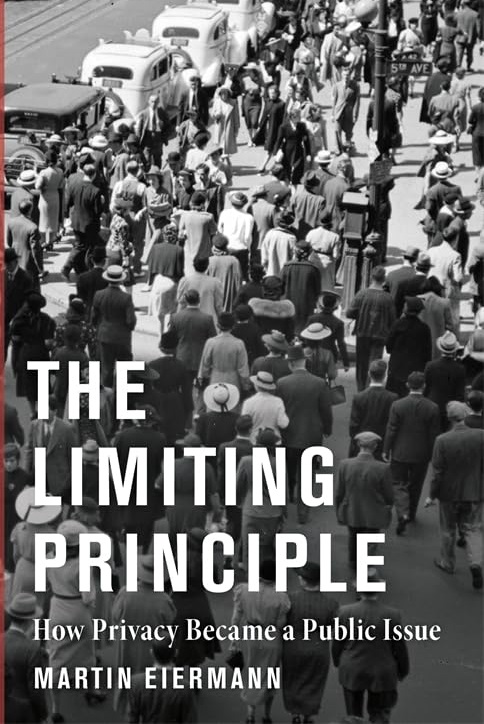
This was not always the case. Before the 1880s, a person had to stand quite literally beneath the eaves of a home to be perceived as an “eavesdropper” who violated reasonable expectations of privacy. In my book, The Limiting Principle: How Privacy Became a Public Issue, I examine the subsequent transformation of privacy from an informal set of social norms about family life and domestic space into an influential logic of social organization that gave structure to the relationships between citizens and the state, and between consumers and corporations.
Between the 1880s and the 1920s, conceptions of privacy that were reactive to modernization and the attendant moral panics escaped the confines of the family home and became embedded into law, jurisprudence, and urban space—often for the first time in American history. This was a time when the United States was experiencing far-reaching social and technological changes. In a nation searching for a new social and institutional order, the logic of privacy became broad when it subsumed a vast array of discussions under one conceptual roof and merged disparate conceptions of the social and moral order into the language of spatial and informational access. Privacy also became sticky. To a much greater extent than before, the management of privacy began to involve codified rules and regulations rather than locked doors and social custom.
This growing salience in politics and public life reflected the fact that privacy was often won and lost at scale, since the greatest threats to privacy increasingly came from institutional actors. One direct consequence was the gradual recognition of a justiciable “right to privacy”, because the law has long been one of the most powerful instruments for the production and reproduction of social order in the United States. Today, this right is primarily understood as a state-centric right that offers protections against governmental intrusions into the home or governmental interference with reproductive decision-making. However, early American privacy jurisprudence was squarely focused on the private sector and developed during legal disputes about the unauthorized use of photographs by yellow press journalists and the use of a person’s name by advertising agencies. Until World War I and the Prohibition Era—when government censorship of the mail reached new heights, and police raids became a key strategy for curbing the production and distribution of liquor—many Americans were more skeptical of claims about governmental overreach. As the influential philosopher John Dewey put it dismissively, “all the early Victorian political platitudes” about individual rights were poorly suited to an age where the greatest threats to society appeared to come from unchecked market actors rather than from an overbearing state.
Only in recent decades have questions about consumer data risen back to the forefront of judicial debates about “surveillance capitalism,” bridging across a century of comparative neglect. From Virginia to California, U.S. states have now adopted dedicated consumer privacy laws that regulate how online platforms and data brokers can collect, use, and share personal data. On the one hand, such laws represent a departure from privacy governance during the twentieth century, when data collection by non-state entities was often relegated to a judicial backwater. On the other hand, even the recent wave of legislation is often most successful at encoding what Ari Ezra Waldman has called “symbols of compliance” while offering much more limited substantive protections.
It is also instructive to consider the negative case of a domain that was never fully brought under the privacy umbrella. Since the introduction of commercial and consumer credit scoring in the late nineteenth century, the collection of personal financial data by rating agencies and lenders has been primarily regarded as a beneficent technology of financial inclusion, not as potentially exploitative consumer surveillance. As one observer already noted in the early twentieth century, “the difficulty of appraising credit worth on any basis other than the ownership of readily negotiable collateral led to the denial of credit to classes of consumers whose credit needs were supplied by banks in intimate communities.”
Structural changes to American consumer capitalism increased the collection and circulation of personal data more rapidly than any governmental attempt to collect business income data through the Internal Revenue Service or any attempt by penny press newspapers to expose individual misconduct. Such credit reports generated occasional opposition from businessmen whose reputations and dealings had been harmed by unfavorable reports, yet they also made it possible for a wider swath of the American populace to access monetary resources at a time when localized systems of providing credit (based on interpersonal trust and reputation) were falling out of fashion. American consumers repeatedly consented to, desired, or at least tolerated the sharing of personal information, contingent not just on prevalent cultural norms but on the expected benefits. The valued consumer became a visible consumer.
This holds a lesson for today, where many companies find informational privacy incompatible with their business models and consumers may decide to trade it away for added convenience. In a world of surveillance capitalism, the logic of privacy often dwells in the uncanny valley of information politics: It has completed the proverbial march through the institutions and has become integral to the organization and functioning of modern society. Yet it also remains a comforting fiction that the existence of formal privacy rights offers substantive protection against the exercise of corporate power or that the perceived benefits of privacy necessarily outweigh the perceived benefits of exposure. As the writer Franny Choi once put it, “truth is, I wanted to be known, cracked open by gentle hands.” The apparently inescapable collection of personal data is often matched by practices of proactive self-promotion and voluntary data-sharing.
This does not mean that privacy is dead. Driving through Silicon Valley, one is struck by the number of billboards that still elevate privacy into a sales pitch by asserting that hardware and software are “designed from the ground up to protect your privacy.” The collection and use of financial data are also regulated through the Fair Credit Reporting Act and the Gramm-Leach-Bliley Act. But the historical twists and turns lend credence to the claim that burdening privacy with grand hopes of political or economic empowerment can easily lead it to buckle under the load. Technological innovations and capitalist development have not made privacy impossible, like an antiquated idea that is now destined for the dustbin of history. Yet we must not place so much faith in the power of concealment.
———–
* Martin Eiermann is Assistant Professor of Sociology at the University of Wisconsin-Madison, where his research uses archival and computational methods to examine patterns of institutional contact and the politics of personal data in the Information Age. His current book is The Limiting Principle: How Privacy Became a Public Issue (Columbia University Press, 2025).
***
Since you find value in the content and resources shared by the ES/PE community, please consider making a contribution to help sustain our work. Your support is vital to maintaining our independence and carrying forward our mission. Intellectual and civic solidarity matters now more than ever. Every contribution makes a meaningful difference and helps ensure the continuation of accessible scholarship and useful information. Donate securely now via this PayPal link. Thank you!
Discover more from Economic Sociology & Political Economy
Subscribe to get the latest posts sent to your email.
