
by Crawford Spence*
There is plenty of work out there on financial intermediaries. Most of this can be found in finance or economics journals and displays little evidence of its authors having spent any time with financial intermediaries at all. Rather, studies looking at asset managers or investment bankers tend to be carried out at a distance, using quantitative measures of investment outputs or analyst reports. Although this work is valuable on some levels, it genuinely fails to capture the social or interactional aspects of what financial intermediaries do and indeed often paints a picture of financial intermediation that is quite distorted.
More considered and thoughtful studies are offered by behavioural economics and behavioural finance, pointing out where rationality fails and bias and distortion creep in. Yet behavioural work doesn’t go far enough. Irrationality and cognitive bias often have a social or cultural basis to them, which economists are generally woefully ill equipped to try and make sense of.
Luckily, we have sociological frameworks that can be deployed to make sense of how financial intermediaries operate, what they actually do, and why society continues to tolerate them even when their economic utility is highly questionable.
Making sense of the asset management field
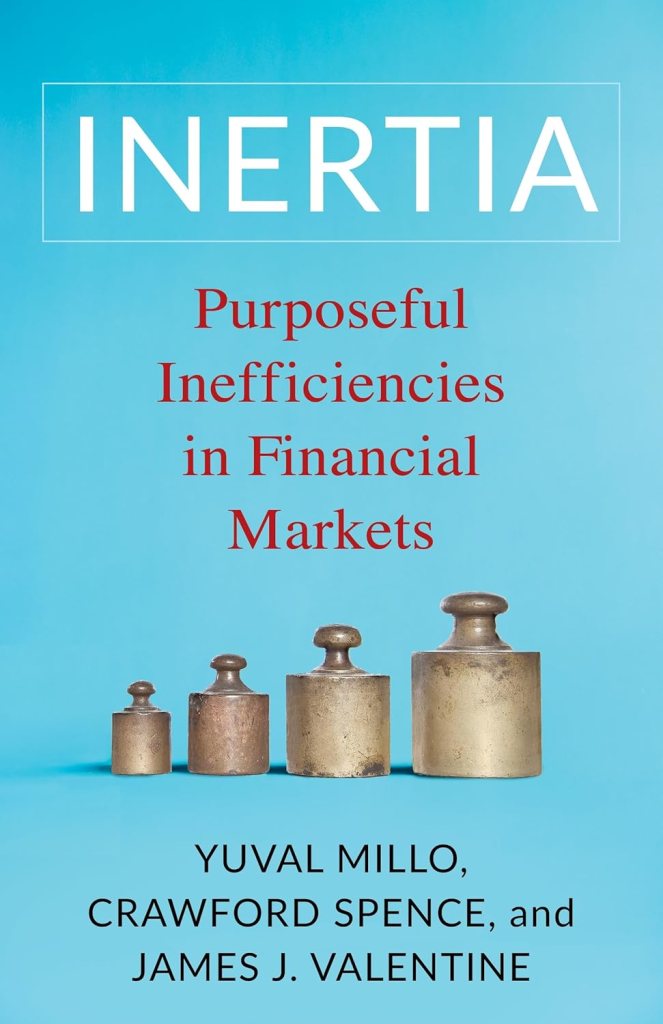
This book, Inertia: Purposeful Inefficiencies in Financial Markets, by Yuval Millo, Crawford Spence, and James J. Valentine (Columbia University Press, 2025) seeks to explore these concerns by drawing on the work of Pierre Bourdieu and Marc Granovetter primarily. These conceptual sources are applied to a qualitative field study of asset managers and their equity advisors from investment banks in both the UK and the US. 70 financial intermediaries were engaged as part of the study, which explored in detail the practices and interactions that surround investment decision making. Specifically, we look at how the buy-side, which consists of fund managers, hedge fund managers and in-house analysts, develop relationships with sell-side analysts from investment banks and corporate managers that both grow and congeal over time. The result is a book that offers insights into both financial intermediation and economic action more broadly.
With the rise of passive investing in the form of index funds and ETFs, the active investment community’s legitimacy is thrown into relief and it is finding itself facing an existential threat. Communities that are under threat tend to become more vocal and explicit in how they talk about themselves. This affords researchers an opportunity to gaze into both their epistemic assumptions and the social structures that underpin these. This is exactly what we do in this book. Effectively, we look at the dense, congealed social networks that form over time between key actors in the active investment space. These congealed networks form the basis of an epistemic regime (following Robert Seyfert) – or knowledge base – which has both interpersonal and interinstitutional support that go a long way to explaining why this epistemic regime continues to persist despite both internal and external challenges to it.
These interpersonal and interinstitutional dependencies result in a dense social network that provides stability – if not utility – to the asset management field.
Social stickiness and inertia
These dense social networks are essential to the cultivation of expertise, yet we find that status and legitimacy are often conferred via a much shallower set of metrics. This mismatch between the substantive work undertaken by intermediaries and how they are perceived is common to many expert fields. Financial intermediaries see themselves as trusted investment consigliere who have a lot to offer their buy-side clients in terms of acting as a rich sounding board for ideas, yet they find themselves mostly scrutinised and judged on whether or not their earnings forecasts are accurate (something that most fund managers claim not to have an interest in). This is interesting because it demonstrates how a dense social network acts to cultivate strong social ties and a relatively solid epistemic regime yet also encourages relatively shallow and weak information signals to flow out of that network into the wider market. Conceptually, this shows how financial intermediaries are under contradictory pressures to be both distinctive and to herd together at the same time, forcing them to play a dual game that challenges their identity.
The field of investment advice therefore has its ‘rules of the game’, which are structured and written vis-à-vis the relationships that surround the field’s actors. These rules become internalised and take the form of long-lasting dispositions of the mind and body, or habitus, as Bourdieu pithily summarises the process of rule absorption. The growth of passive investing strategies challenges this habitus. How financial intermediaries respond to this threat intellectually reveals the solidity of their epistemic regime. We find cognitive dissonance in this respect, with many actors conceding the superiority of passive funds to the point where some even admit to investing their own money in index vehicles. However, this seemingly defeatist stance is coupled with a robust intellectual defence. Active investing is seen as superior in many respects and indeed as necessary to the health, vitality and efficiency of the wider market. This epistemological chauvinism shows the solidity of the active community’s epistemic regime and the extent to which social and mental structures are congealed in the field of investment advice.
The book concludes with a synthesis of the various ideas and findings that we highlight in each of the previous substantive chapters. Specifically, we advance the idea of purposeful inertia to capture the complex reproduction of ideas and relationships in the field of investment advice. We stress that the inertia we identify is not a product of lethargy or laziness but rather is purposeful because a lot of energy goes into defending and maintaining the status quo.
———
* Crawford Spence is professor of accounting with broader interests in economic sociology. He is currently codirector of the FinWork Futures Research Centre at King’s College London.
***
Since you find value in the content and resources shared by the ES/PE community, please consider making a contribution to help sustain our work. Your support is vital to maintaining our independence and carrying forward our mission. You can donate securely now via this PayPal link. Every contribution makes a meaningful difference and helps ensure the continuation of accessible scholarship and useful information. Thank you for being part of this community!
Discover more from Economic Sociology & Political Economy
Subscribe to get the latest posts sent to your email.
