
by Basak Kus*
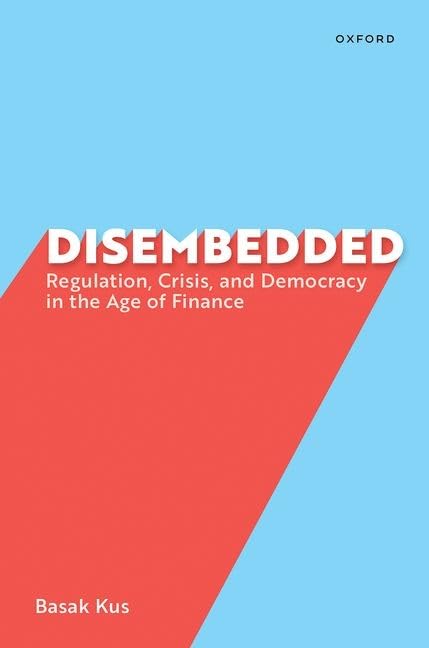
It has now been almost two decades since the 2007-10 financial crisis shattered the exuberance that surrounded American capitalism in the 1990s. The immediate issues the crisis posed—negative growth rates, rising unemployment, and falling stock prices—were addressed long ago. Crises like the Great Recession, however, are more than temporary setbacks; they necessitate a rethinking of the deep-seated assumptions and structural mechanisms underpinning economic processes. With this in mind, one of my goals in writing Disembedded was to provide a historical perspective on the US financial crisis and explore the regulatory environment in which the American economy financialized and the roots of the crisis took hold.
Disembedded examines the remaking of the American regulatory state during the four decades leading up to the financial crisis, a period marked by major structural changes in both the economy (financialization) and the state’s relationship to the economy (the neoliberal turn). The book questions the mainstream account of the crisis and the underlying state-economy relationship: namely, that the US government, driven by neoliberal ideas, implemented deregulatory policies that allowed financial institutions to engage in excessive risk-taking until they eventually crashed—an account which, while not entirely wrong, overshadows and simplifies some of the underlying complexities. With that in mind, I sought to unpack what this neoliberal turn comprised in terms of regulatory ideas and policies, and how it impacted the risk formations of a financializing economy.
Neoliberal Ideas Rightly Understood
To begin with, we need a clearer understanding of the specific ideas that shaped the state’s regulatory relationship with the financializing economy and how they gained political traction. When the neoliberal turn is discussed in terms of its ideational content, Friedrich Hayek, Milton Friedman, and the Mont Pelerin Society are often invoked as the intellectual forces propelling the shift toward “the market,” a concept conveniently kept abstract and unspecified. While it is not inaccurate to frame neoliberalism broadly as a Hayekian or Friedmanite intellectual movement, focusing solely on these figures can obscure the specific programmatic ideas that shaped policy on the ground and the intellectual agents behind them who, as Quinn Slobodian argues, got their hands dirty “advising business, pressuring governments, drawing up charts, and gathering statistics.”
In the book, I trace the regulatory environment of American financialization to the rise of an intellectual movement in the works of economists like George Stigler, Sam Peltzman, Gary Becker, James M. Buchanan, Gordon Tullock, Anne Krueger, William A. Niskanen, and others in the 1970s and 1980s. While they varied in their specific arguments—be it the danger of regulatory capture, the phenomenon of rent-seeking, or the inherent limitations of bureaucracy as an administrative technique—all these theorists joined in their critique of direct and substantive government regulation. In the 1990s this anti-statist regulatory movement gained further momentum from the increasingly influential field of financial economics and the rising popularity of the New Public Management theory of government.
Beyond Deregulation
What were the policy tools inspired by these ideas? The literature often talks about deregulation. Surely deregulation was an important part of it. It was the rolling back numerous financial regulations established in the wake of the Great Depression, in conjunction with technological advancements, that led to the emergence of new market players and instruments. However, this was not simply a shift from more rules to fewer or no rules; the changes in the policy landscape have been more complex and far-reaching. It involved a profound redefinition of the roles and responsibilities of both the government and market actors in mitigating risk. For one, the government did not adopt necessary measures to develop substantive risk regulation tools to respond to the evolving realities of financial markets, giving rise to another, highly important but less mentioned facet of neoliberal politics: regulatory drift.
More importantly, when and where the government did regulate, it increasingly aligned with the premises of market discipline and individual rationality: it markedly pivoted toward a micro-orientation in regulation, focusing prudential regulation on the stability and security of individual entities rather than the entire system (micro-prudential regulation) and entrusting financial institutions with defining the terms of risk management, premised on the belief that these entities were best equipped to handle this responsibility (a practice known as principles-based risk regulation). Furthermore, it heavily relied on information-based regulation. The rise of disclosure requirements, the growing prominence of credit rating agencies, and the expansion of financial literacy programs were all integral to this transition.
Risk Protection Deficit as a Structural Feature of American Capitalism
The narrative of “financial institutions taking excessive risk” also requires reconsideration. It characterizes risk as something an individual actor takes or avoids, essentially portraying it as manageable through the responsible actions of individual firms, and thereby obscures the systemic nature of risk. We should focus instead on the deficit in risk protection as a structural feature of the American political economy, which I conceptualize as “disembeddedness,” inspired by Karl Polanyi’s work. This deficit was observed not only in the government’s mitigation of systemic risk but also in consumer financial protection.
The increasing size and complexity of financial markets, coupled with households’ reliance on them for everything from using credit cards to investing in 401K plans, were facilitated by global and technological forces—major structural shifts beyond individual control—at a time when formal and collective structures of risk protection were weakening, and an emphasis on individual accountability was becoming prevalent. In this context, disembedded financialization was characterized by the twin processes of what Ulrich Beck calls “organized irresponsibility” and “tragic individualization.” The increasingly complex financialized economy made it difficult to pinpoint who and what were responsible for creating risk, which empowered economists as experts. Simultaneously, people were left to fend for themselves- a process, which Beck describes as “disembedding without embedding.”
Questions of Regulation Are Inherently About Democracy
Finally, Disembedded offers a way of thinking about regulation and regulatory reform as matters of democracy. Often, questions of regulation are seen as obscure matters subject to technocratic analyses. This cannot be further from the truth. However, as K. Sabeel Rahman notes, it would be misleading to see regulation simply “as a matter of closing market failures, promoting efficiency, and focusing on techniques of expert and technocratic judgment”; rather, we need to approach it “as a project of counteracting imbalances of power in the modern economy, and of creating a more inclusive, balanced, and productive form of democratic contestation and collective problem-solving.” When evaluating the government’s response to the crisis, as well, the measure should not be just the speed of recovery but, more importantly, whether and how adequately the ensuing regulatory reform addressed the protective deficiencies underpinning this disembeddedness of the economy.
By the time the financial crisis began in 2007, public discontent with Washington was already high and only intensified during the course of it. As Jonathan Hopkin put it, “when the wheels came off,” the public found that “conventional democratic politics was unable to provide adequate solutions to the acute economic distress this caused.” Trust in government declined as evidenced by various polls. Trump effectively capitalized on this discontent, channeling everyday Americans’ confusion with financial markets. In a campaign speech, he attacked Wall Street as “a global power structure that is responsible for the economic decisions that have robbed our working class, stripped our country of its wealth, and put that money into the pockets of a handful of large corporations and political entities.” These messages clearly resonated with the American public.
This is not to say that economic factors and the fallout from the financial crisis alone explain the rise of anti-establishment politics. In the case of US, racial and ethnic resentments, along with an array of cultural factors, clearly play an important role. Still, their role warrants scrutiny, especially given the historical precedent that Polanyi astutely analyzed.
————–
* Basak Kus is Associate Professor of Government at Wesleyan University. She teaches and writes about the interplay of the state, capitalism, and democracy. Her work to date has focused on themes such as economic crises and liberalization reforms, the restructuring of the welfare state, state-labor union relations, regulation of the financial sector, financialization, debt, and the politics of inequality.
***
Feel free to share this post with your colleagues, students and friends.
Follow Economic Sociology & Political Economy community on
Facebook / X / LinkedIn / Whatsapp / Instagram / Tumblr
Telegram / Threads / Mastodon
Discover more from Economic Sociology & Political Economy
Subscribe to get the latest posts sent to your email.
