
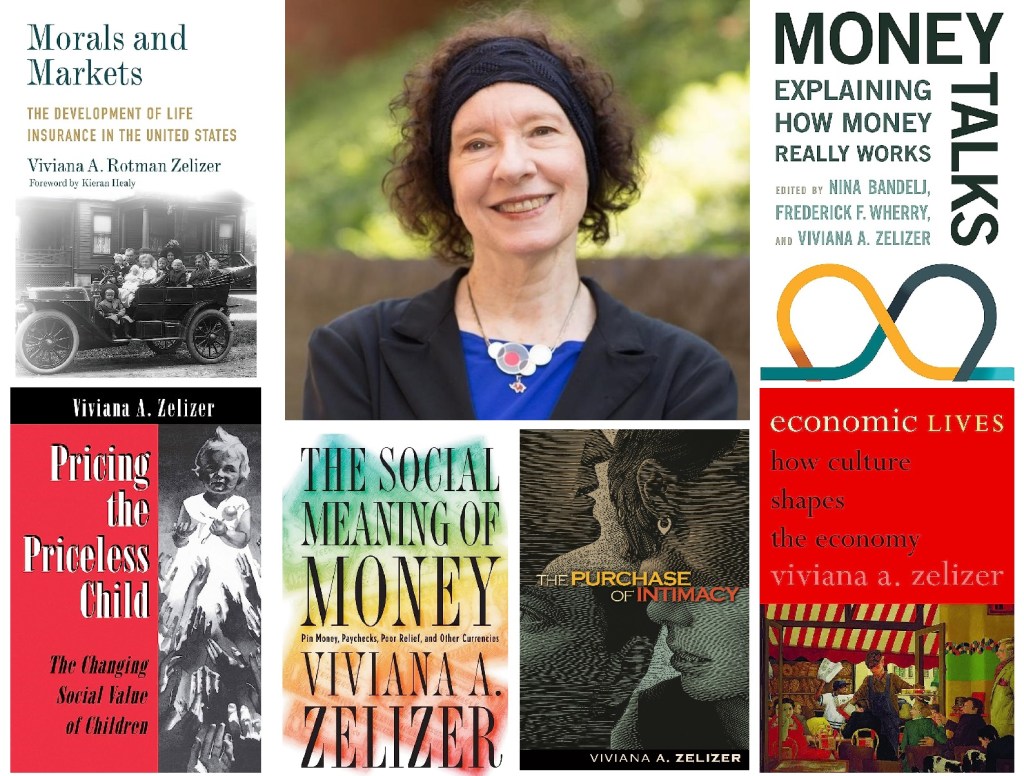
The American Sociological Association solutes an eminent scholar and groundbreaking economic sociologist Viviana Zelizer with the W.E.B. Du Bois Career of Distinguished Scholarship Award, its highest honor, and the Distinguished Career Award for the Practice of Sociology, its second major honor. Presenting Professor Zelizer with the Association’s two most prestigious awards at the same year is, apparently, an unprecedented fact that indicates Zelizer’s unique and momentous intellectual contribution.
“Transformative. Pioneering. Iconoclastic. Those were the words the selection committee kept returning to when considering the work of Viviana Zelizer”, the ASA announced. “Considered by many one of the greatest and internationally impactful living sociologists, Prof. Zelizer has, over a career spanning more than four decades, made field-defining and generative contributions to various areas, including Economic Sociology, the Sociology of Childhood, the Sociology of Intimacy, and perhaps most fundamentally, the Sociology of Money. More precisely, Zelizer’s scholarship has not simply added to existing lines of inquiry in these fields; in all cases, Zelizer’s work constituted veritable intellectual revolutions, generating whole lines of scholarship where there were virtually none.
As a result, contemporary economic sociology has taken a decided “Zelizerian” turn, with core concepts and methodological and analytic approaches in the field either traceable directly to Zelizer’s work or the scores of students and acolytes whose work she has influenced and profoundly shaped. In this respect, Zelizer’s tremendous impact has been realized as much by her tireless mentorship of numerous women and scholars of color, leading to the wholesale transformation of both the face and the thematic orientations of various fields central to contemporary sociology. No other scholar has done more to shape the foundations of the sociological study of economic life in contemporary sociology, with her work serving as the cornerstone of multiple thriving and expanding paradigms in the field, including the “morals and markets” and “relational work” approaches. Nevertheless, Zelizer’s multifarious contributions do not stop there. Her work has profoundly influenced fields such as the sociology of morality, the study of markets and evaluation, consumers and consumption, gender and sexuality, the sociology of law and the family, and many more.”
Along with dozens of academic articles, Zelizer’s brilliant research is reflected in four masterpieces. Her first book Morals and Markets: The Development of Life Insurance in the United States (1979 / 2017) demonstrated the deep cultural, moral, and institutional work required for new markets, pioneering a deeply sociological and historically grounded approach to market emergence. Her second book Pricing the Priceless Child: The Changing Social Value of Children (1985 / 1994) traced changing cultural understandings of the “value” of children — from “profane” contributors to family subsistence to “sacred” and “priceless” individuals who needed to be protected from the strictures of the market — that produced new tensions when markets for children’s life insurance started. In her third book The Social Meaning of Money (1994 / 2017), Zelizer showed how money in particular and monetary exchange more generally, rather than being an impersonal and ‘objective’ mechanism for market transactions, is fundamental in the definition and constitution of diverse types of social relations. The book cemented the “relational work” paradigm, which was continued in her fourth book The Purchase of Intimacy (2005) that expanded the empirical and theoretical scope of economic sociology to examine the economic aspects of intimate social relationships, moving beyond the idea of an antithesis between market transactions and emotionally significant ties. All Zelizer’s books exemplify a rare feature in academia — they are easy to read and comprehend. Her writings are just as clear and lucid as her assertions are bright and illuminating.
In the citation for the Distinguished Career Award for the Practice of Sociology, the selection committee commended Zelizer as “an outstanding ambassador for sociology, globally and outside our discipline. She has advanced sociology by fundamentally reorienting multiple subfields within the discipline and claimed novel space for sociological inquiry into economic processes. […] Her scholarship has also powerfully influenced researchers outside of sociology, including legal scholars, anthropologists, historians, behavioral economists, feminist economists, political scientists, and business scholars, among others. […] The charge of the Distinguished Career Award for the Practice of Sociology is to select an honoree whose work has served as a model for others, has elevated the professional status or public image of the field outside of sociology, and has been widely recognized for its significant impacts. Zelizer is most deserving of this award because she has done all the above.”
Born and raised in Argentina, Zelizer studied law in the University of Buenos Aires. Following her immigration to the United States, she received her BA degree at Rutgers and her MA and PhD degrees at Columbia. She taught at Rutgers, Columbia, and Barnard before moving to Princeton in 1988. Zelizer’s outstanding scholarship was recognized with many prizes in the US and worldwide. In 2001, she was the elected the first chair of the newly created Economic Sociology section of the American Sociological Association. In 2003 the Economic Sociology section named its annual book prize the Viviana Zelizer Distinguished Book Award. In 2010, a collection of her influential papers and essays appeared in Economic Lives: How Culture Shapes the Economy and in 2017 was published her most recent book Money Talks: Explaining How Money Really Works, co-edited with Nina Bandelj and Frederick Wherry.
On this festive occasion, the Economic Sociology and Political Economy community enthusiastically applauds Professor Zelizer and expresses gratitude to her for planting and sustaining the field of knowledge that we all gladly harvest and reverentially keep up.
***
Join Economic Sociology & Political Economy community via
Facebook / Twitter / LinkedIn / Whatsapp / Instagram / Tumblr / Telegram
Discover more from Economic Sociology & Political Economy
Subscribe to get the latest posts sent to your email.
