
by Jawied Nawabi*
At least, since the end of WWII the world has advanced significantly in scientific knowledge, technology, and the institutionalization of universal human rights conventions, yet there still prevails enormous levels of inequality, malnutrition, and poverty in the world. With all our advancements in the social sciences in the past seven decades on how to help countries develop yet so few countries, from about 130 newly independent countries, have still not achieved successful development results. This begs the question for why is it that so few countries have still not achieved successful development results? Why are there different qualities of states in the world?
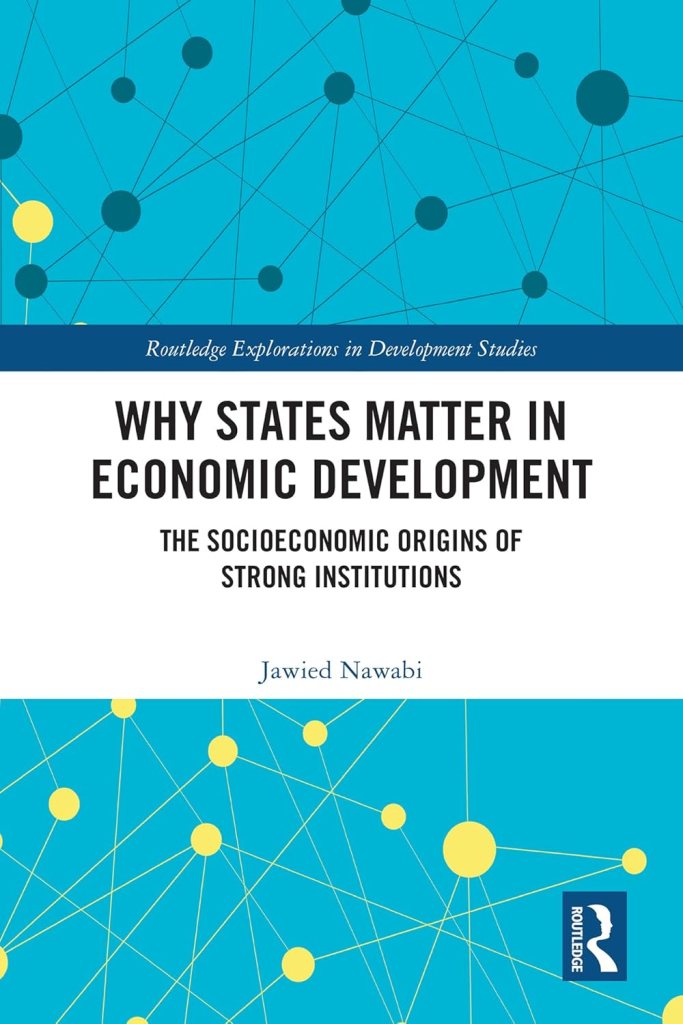
My new book Why States Matter in Economic Development: The Socioeconomic Origins of Strong Institutions aims to analyze the question: what are the underlying conditions that give rise to states that are effective, efficient, and inclusive bureaucratically with their developmental policies, as opposed to bureaucratically incompetent and captured states which is typical of most states in the developing world? This book also wants to make the case for why the state institution is important in advancing the socioeconomic development of their populations and how good state institutions form. Its major theme focuses on the role of the state in the political economy of development and traces the socio-economic origins of effective state institutions from a comparative historical-institutional perspective, using the case studies of: South Korea, Brazil and India compared to three European countries of England, France and Spain. While there’s significant scholarship and political debates on the Weberian administrative functions of the state and whether or not the state plays an important role in the political economy of nations buffeted by the global economy, there remains a gap in the literature explaining the socioeconomic roots of Developmental States.
Theories of economic development in the capitalist system have two axes around which they revolve: market-led development versus state-led development. They can be distinguished conceptually by the centrality of the state’s role in “governing the market.” A central factor in each of these theories is the role of the state and how it contributes or undermines the prospective of development or underdevelopment of nations. On the far right of the political spectrum, in the last 50 years, there has been the neoliberal onslaught attacking the state’s role in the economy which has led to the retreat of the institutions of the state and as a result a roll-back of the state-led development while on the left of the spectrum, in response, there is a growing push back that the relationship between the state and market need not be a zero-sum relationship, but rather can be one of synergy.
This book aims to analyze the agrarian conditions that give rise to states that are inclusive bureaucratically with their developmental policies, as opposed to bureaucratically incompetent and captured states. The main argument is that developmental states are built on the premise of how effectively state actors are able to weaken the power of the country’s landlord class during the initial years of state-building. The power balance between the two classes, determines the developmental trajectory of the state. Only when state actors are able to significantly weaken and/or co-opt the landed elites, is the state able to create the capability to build the institutions of a state which are similar to the ones we see today in the developed world; that is states with effective Weberian bureaucracies capable of collecting taxes efficiently while also having the bureaucratic wherewithal to enforce a functioning national legal system and provide sufficient public services and goods. On the contrary, states that have been unable to weaken the landlord class have predominately developed state institutions which have been subject to the manipulation of the country’s landed elite. This factor determines both the ability and pace at which countries experience development.
One of the main differentiating factors of this book compared to the Eurocentric mainstream narrative is to analyze the conditions in the agrarian power dynamics which allowed England to achieve a centralized state with unified laws contributing to faster economic growth than France and Spain. Modern European states emerged from European feudalism which was essentially “an agrarian system built around the control of land” (Dorner, 1972, pg. 34). Therefore, in order to understand how modern states emerged, we have to analyze the agrarian power relationships between the different classes of European feudalism. England was able to progress faster economically and professionalize the state bureaucracy than Spain and France due to its monarchy being able to co-opt and diminish the regional power centers of landlords who could influence or challenge the judicial or tax policies of state institutions.
It is within the agrarian class relations and the ensuing power balance between the state (monarchy) and the nobility (landlords) that the process of transition from feudalism to capitalism can also be revealed. These two processes, the emergence of the modern state and capitalism, were not dependent on each other but they shared a symbiotic relationship with each other, or to put it in Weberian language, an elective affinity (Tilly, 1992, pg.72). Therefore, understanding the agrarian roots of the modern state in the emergence of capitalism is fundamental for allowing us to gain insights on how to help the Global South build their state’s capabilities for an effective and efficient capitalist economy (Schwartz, 1990, pg.11; Weiss and Hobson, 1997, pg. 56-57, 71, 88-89). The key focus of my analysis in the book is predicated on the importance of addressing the agrarian power relations in order to form a perspective to sincerely build the state capacities for the majority of Global South states.
Lessons from South Korea to Understand Development in the Global South
This book’s contribution contrasts starkly with the analysis that has been made in past 30-40 years by many seminal works on the Developmental State which is that it points to the agrarian roots to the South Korean case. The “miraculous” success of South Korea (The “Asian Tigers”) is attributed by scholars and policy makers predominately to their successful transition from Import Substitution Industrialization (ISI) to Export Oriented Industrialization (EOI). The point of entrance of such reports and analysis is on the smart technical and industrial policies while they assume that the developmental state had somehow already existed. However, this book makes the case that South Korea which was able to build a state that became developmentally oriented had deep agrarian roots. The industrialization of South Korea was enabled by the forced execution of thorough land reforms under Syngham Rhee that allowed South Korea to build the type of developmental institutions it used to industrialize as well as raise its population’s living standards.
A further analytic framework is analyzing the pattern of colonial rule of South Korea, Brazil and India, which laid the foundations of their modern state institutions. This theoretical approach critically examines how the historical underlying path-dependent conditions of state institutions shapes economic trajectories, and determines their ability to resist dependency, and build autonomous institutions which create a developmental state. This perspective will help us understand how historical colonial institutions that have been passed on countries have a lasting consequence which are not easily reversible even if they are undermining the broader social and economic development of their national goal. In the case of Korea, the state control by landlords that was inherited from the Japanese colonialism was reversed by the shock of the Korean War (1950-1953) whereas most of the developing countries (Brazil and India) have broadly inherited the socioeconomic structures of their colonial legacy during their independence which has prevented them to reconfigure their economies towards a path that benefits the large majority of their populations.
Four Insights
The study of institutions and their effectiveness is key to understanding the differing paths of economic development that countries experience. To study institutions, one has to examine the historical and socioeconomic material roots of their evolution. Studying the ideal models of state-building of the U.S./Western Europe, we gain deep insights on the agrarian power struggles between the state-builders wanting to increase state taxation capacity and the landlords who resisted increased state authority. Understanding this process reveals for us the agrarian roots of how they were able to establish their social/political institutions that transformed the gains of their economic growth into human and social development.
It is only after we understand the long and arduous process behind the success of the European modern states on how they resolved the power balance in their agrarian class relations that we begin to appreciate the colonial legacy (or in other words the path dependency) that the European colonial powers left behind in the countries they had colonized. That is, on the contrary to their own experiences instead of centralizing the infrastructural state powers and creating effective and efficient government administrations in the colonially ruled countries, they strengthened the centrifugal forces of local powers, such as landlords (called zamindars in India or large plantation owners in Latin America) or traditional tribal chiefs through whom they indirectly ruled the territories they occupied and extracted large amounts of raw materials and other services for the advancement of the European powers.
Despite the growing urbanization of the world population this book aims to bring back the unresolved agrarian question of land inequality and the power imbalances that were inherited with post-colonial states and how they continue to be manifested in the political economy of the countries in the Global South. This has implications for the development community’s inability to be able to solve the major socioeconomic and political issues of our time building sufficient and effective state capacity for basic public services so that they can realistically achieve growth with social advances: from helping achieve literacy, health, and gender equity to democratization.
For too long, the topic of land reform has been isolated inside the annals of radical political ideology, often associated with, big government white elephant projects, socialist distribution, and the like. For the past thirty years, mainstream developmental scholarship when it has mentioned land reform it is too often discussed as one of a number of equally “good” policies amongst education, health care, and smart industrial policy that has led to the development of the East Asian “Miracles”. However, the argument of this essay is that thorough land reform has a distinct (sui generis) quality in the sequence of developmental policies. Land reform is the foremost and indispensable policy tool that opens the conditions enabling other “good” policies like education, health care, and effective strategic industrial policies to be realized along an agro-industrial path. In other words, sequence matters in development, just like with a combination lock if one uses all the right numbers but in the wrong sequence the lock will not open. The argument of this essay is that land reform is vital in breaking the structural obstacles that could unleash the dynamic socioeconomic conditions in the building of civil society, institutions, and developmentally oriented states.
I submit that the lessons from South Korea especially the sequence of its development procedure has rich contemporary practical lessons for the policy making world. The hope of this essay’s conclusion is to help stir thinking, formulate policies (i.e. cadastral surveys that can be used to administer land taxes that raises state revenues), and further research in how we can build the infrastructural powers of the Global South states.
Bibliography:
– Chang, Ha-Joon. The Economic Theory of the Developmental State. In Meredith Woo-Cumings (ed.) The Developmental State (182-199). Cornell University Press, 1999.
– Chibber, Vivek. Locked in Place: State-Building and Late Industrialization in India. Princeton University Press, 2011.
– Dorner, Peter. Land Reform and Economic Development. Penguin Books, 1972.
– Evans, Peter. Embedded Autonomy: States & Industrial Transformation. Princeton University Press, 1995.
– Ertman, Thomas. State Formation and State Building in Europe. In Thomas Janoski, Robert Alford, Alexander Hicks, and Mildred A. Schwartz (eds). The Handbook of Political Sociology: States, Civil Societies, and Globalization (367-383). New York: Cambridge University Press, 2005.
– Haggard, Stephan. Developmental States. Cambridge University Press, 2018.
– Kohli, Atul. State-Directed Development: Political Power and Industrialization in the Global Periphery. Cambridge University Press, 2004.
– Schwartz, M. Herman. States versus Markets: The Emergence of a Global Economy. Palgrave Macmillan, 2000.
– Strayer, Joseph, R. On the Medieval Origins of the Modern State. Princeton University Press, 1970.
– Weiss, Linda and John M. Hobson. States and Economic Development: A Comparative Historical Analysis. MA, USA: Polity Press, 1997.
– Tilly, Charles. Coercion, Capital, and European States, AD 990-1990. Boston, Massachusetts: Blackwell Publishing, 1992.
——————–
* Jawied Nawabi is Associate Professor of Economics, Sociology, and International Studies at the City University of New York–Bronx Community College.
***
Since you find value in the content and resources shared by the ES/PE community, please consider making a contribution to help sustain our work. Your support is vital to maintaining our independence and carrying forward our mission. You can donate securely now via this PayPal link. Every contribution makes a meaningful difference and helps ensure the continuation of accessible scholarship and useful information. Thank you for being part of this community!
Discover more from Economic Sociology & Political Economy
Subscribe to get the latest posts sent to your email.
