
by Patrick Honohan*, Governor of the Central Bank of Ireland (2009-15)
That politicians should leave it to central banks to set interest rates in such a way that price stability is maintained (and restored whenever it is lost), has been an article of faith with most economists, especially since the stagflation of the 1970s given the way in which it was brought to an end, notably by the Volcker Fed in the United States, using measures unpalatable to most politicians. In more recent times, central bank credibility has taken a bit of a knock, what with the rapid post-pandemic surge in inflation almost everywhere, even though the corrective action—sizable and sharp when, eventually, it came—has been quite effective in bringing inflation rates back within shouting distance of target.
The tasks mandated to central banks often extend beyond price stability to include a range of goals for the financial sector, such as: an efficient and cost-effective payments system; prudential supervision of banks; the preservation of financial stability; and the management of financial crises when they break out. Is the much-vaunted independence of the central bank necessary in these areas also? That is less clear.
The most convincing theoretical arguments for insulating monetary policy (with its goal of price stability) from elected politicians is, of course, the problem of time consistency. Loosely speaking, this problem arises because everyone knows that politicians will be tempted to try to buy a little more economic activity at the cost of higher inflation. As a result, a regime which leaves monetary policy decisions in the hands of elected politicians will tend to result in higher inflation than could be obtained, without actually achieving lower unemployment. If independent responsibility for monetary policy is given to a central bank that is not tempted to seek short-term activity gains at the expense of inflation, the problem of time consistency may be overcome. And indeed, a body of empirical evidence does suggest that there is something to this in practice.
Different types of argument can be used to support independence of the prudential regulator of banks and other financial institutions from elected politicians. Although such arguments are less sophisticated, they are not without merit, as is shown by the frequency with managerial looting of banks has been associated with political corruption in many countries around the world, as immoral bank insiders cosied up with powerful public officials.
Maintenance of financial stability sometimes involves tools, such as ceilings on the loan-to-value ratio of bank mortgages, which have sharp and obvious distributional effects, both as between generations and as between prosperous and lower income would-be purchasers of housing. Whether central banks or other financial regulators should be assigned the independent authority to impose such selectively intrusive measures is quite unclear. In many countries unelected officials are confined to an advisory role in this kind of area.
When it comes to managing a financial crisis there is no doubt that the central bank will be at the centre of things. As Willie Sutton (the famous American bank robber of the 1930s) was fond of pointing out, banks are where the money is. And the central bank is the only entity that can be relied upon to have the capacity to produce whatever amount of local currency liquidity is needed to quench the flames of an emerging crisis. But that is where the crisis management decisions become difficult. Using the power of the printing press to bail-out every failing financial institution and their creditors on any occasion that someone gets into difficulty is unlikely to be an optimal approach to crisis management. Not only will this encourage reckless behaviour on the part of financiers – the notorious moral hazard – but it can impose wider costs on society, either by generating an inflation tax as a result of the provision of liquidity or through taxation made necessary when the failing institution turns out to be not only illiquid but also balance sheet insolvent.
Three things are needed from the central bank facing an emerging crisis. First of all, it needs to form a judgement on what it will take to contain the crisis from metastasizing into a general loss of business confidence spreading throughout the economy and resulting in severe output and employment losses. Second, it needs to use its policy tools quickly, and at sufficient scale, and it needs to accompany this with clear and convincing communication explaining its strategy including an indication of its contingency plans. Third, it needs to convince the government of what are the complementary actions, not within the toolbox of the central bank, that the government should activate. Importantly, this advice should extent to cautioning the government against measures that are unnecessarily lavish in terms of bailing out the creditors of failing institutions. This third dimension need not compromise the central bank’s independence, but it clearly requires, as a prerequisite, the establishment of a relationship of mutual understanding and trust going well beyond what is required in the business as usual operations of central bank.
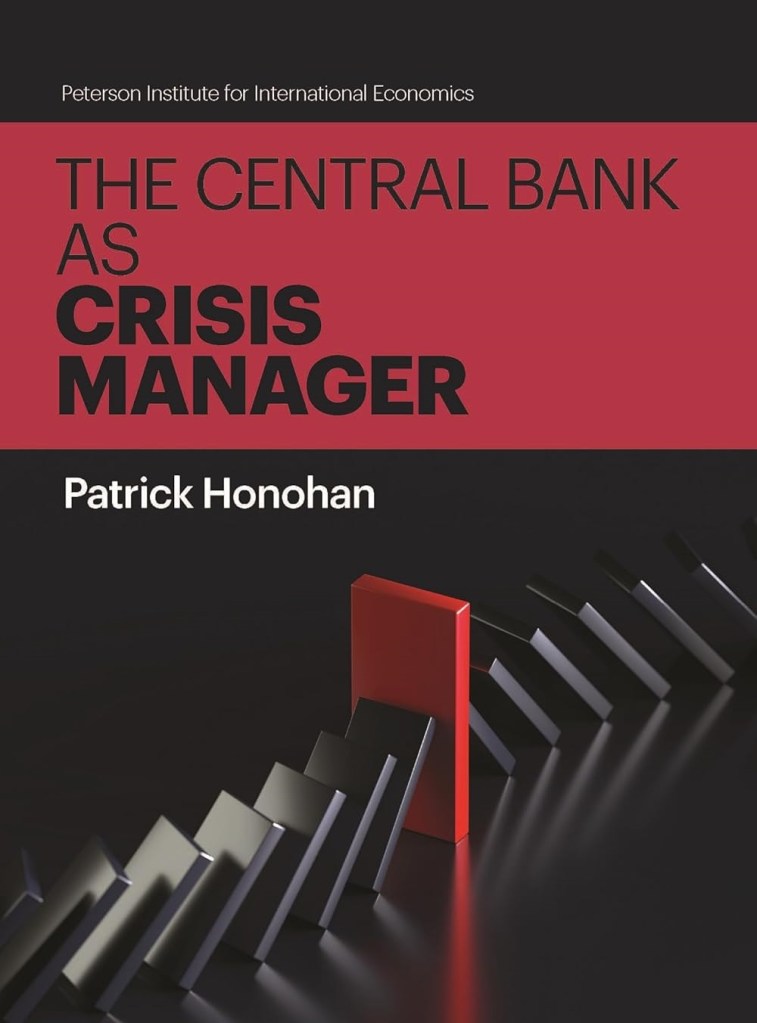
My new book The Central Bank as Crisis Manager explores these issues. It draws on recent experience across four continents as central banks tackled a range of different types of financial crisis. Only one of the cases goes back before the global financial crisis, so they are all relevant to what has become an increasingly complex financial world. In every one of the cases, central bank-government relations were of key importance.
For example, in the failure of Credit Suisse in March 2023, the Swiss Government enacted emergency legislation mid-week to give the Swiss National Bank powers that facilitated its management of the bank’s approach to failure. Another complex example of central bank-government interaction comes from an episode during September 2022, when the Bank of England found itself in an extremely awkward situation (vis-à-vis the UK Government) as it maneuvered to restore financial market functioning in the face of turbulence that had been triggered by the Government’s poorly designed and presented budget. (The Prime Minister and Chancelor of the Exchequer both resigned in the aftermath.) And at the heart of the failure of the 2015-18 Macri Government in Argentina to stabilize that economy was the way in which the relationship between Banco Central de la República and the Government evolved in those years.
Financial crises all differ in sometimes subtle ways from one another. “This time is different” is always true, but cannot be taken as a reason to relax vigilance. In order to be ready to deal with the next financial crisis, central banks should be constantly preparing the ground. My book make a number of practical suggestions on how this should be done. Ensuring that a solid and trusting relationship on financial stability issues has been built between the central bank and the government, and is being maintained, is one of the central desiderata in such preparation.
—————–
* Patrick Honohan is a nonresident senior fellow at the Peterson Institute for International Economics. He was governor of the Central Bank of Ireland and member of the governing council of the European Central Bank (2009-2015). Among his books are Europe and the Transformation of the Irish Economy (with John FitzGerald, 2023), Currency, Credit and Crisis: Central Banking in Ireland and Europe (2019), Finance for All? Policies and Pitfalls in Expanding Access (with Thorsten Beck and Asli Demirguc-Kunt, 2008), and Financial Liberalization: How Far, How Fast? (with Gerard Caprio and Joseph E. Stiglitz, 2006).
****
While you enjoy and benefit from the ES/PE community’s contents and useful information, please consider making a donation to endorse and support our work. Your contribution will ensure the ES/PE community’s independence and sustain our mission. Donate safely now via this PayPal link. Thank you
Discover more from Economic Sociology & Political Economy
Subscribe to get the latest posts sent to your email.
